Aberdeenshire Council’s July 2026 guidance distinguishes incidental accommodation, ancillary accommodation, and a separate dwelling. It treats the question as one of fact and degree, not as a test answered by a label such as “annexe” or by the presence of a kitchen. Review the current Incidental and Ancillary Accommodation Guidance alongside the property’s planning history and current local plan.
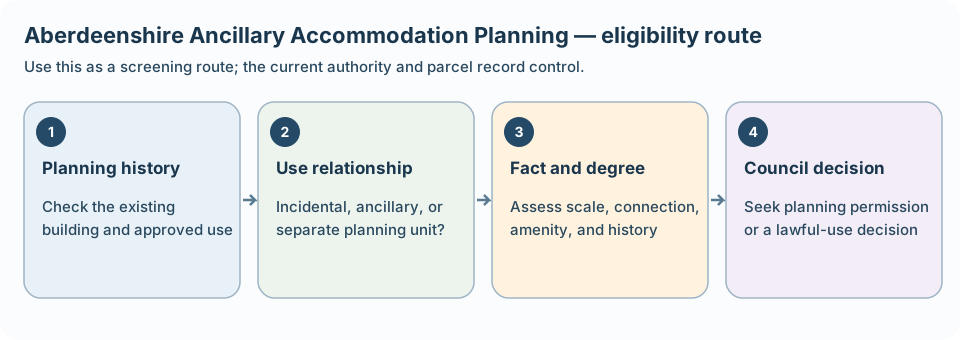
Check the building’s planning history and relationship to the home
The Council says an existing attached or detached Class 9 building may remain in that use where the planning history and absence of a separate planning unit support the classification. A detached building with standalone ancillary dwelling use will normally require planning permission. Creating functionally separate units through subdivision also requires planning approval.
The Council’s assessment considers the building’s subordination, scale and design, relationship and connection to the main dwelling, privacy and amenity, planning history, and supporting information. A self-contained kitchen or other independent facilities do not, on their own, determine whether the use has become a separate dwelling.
Get a property-specific decision
This is Aberdeenshire’s non-statutory local guidance, not a Scotland-wide rule or a decision about an individual property. If the planning history, established use, or proposed connection is unclear, ask the Council whether a planning application or formal confirmation is needed before converting or occupying the building.