An ADU rule can be proposed, adopted but not yet effective, amended, or limited to named properties. Before relying on it, identify the current text and confirm that it covers the parcel and proposed form.
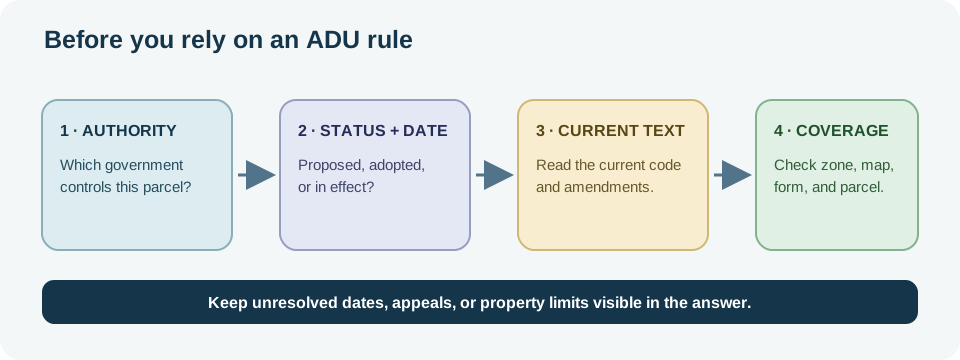
Trace the rule through its legal status
Start with the government that controls the parcel and find the ordinance, statute, by-law, or regulation containing the use rule. A staff report, recommendation, or bill marked “introduced” or “in committee” is not enacted law. An adopted instrument may have a later effective date, an appeal path, or a later amendment. Record adoption, effective, and consolidation dates separately, then check the current code against later enacted instruments.
Match the rule to the parcel
Read the provision’s geographic limits, zoning district, principal-dwelling form, and project type. Check the official map and any overlay, certification, appeal, or property record that can narrow its reach.
Toronto’s notice says By-law 214-2026 passed on March 26, 2026, for odd-numbered properties from 91 to 209 Parkmount Road and 160 Mountjoy Avenue. It gives an April 28 appeal deadline, but does not establish any appeal result or apply the change to other properties. A passed deadline alone does not prove that no appeal was filed.
Keep an auditable answer
Record the authority, exact instrument, status and effective date, parcel zone or mapped area, proposed form, and unresolved checks. If the code or appeal status is uncertain, report that limit and ask the planning office which text applies today.
This is a method for checking rule status, not a live amendment tracker or a parcel clearance. For the broader property workflow, see how to screen an ADU property and how zoning permission varies by form.