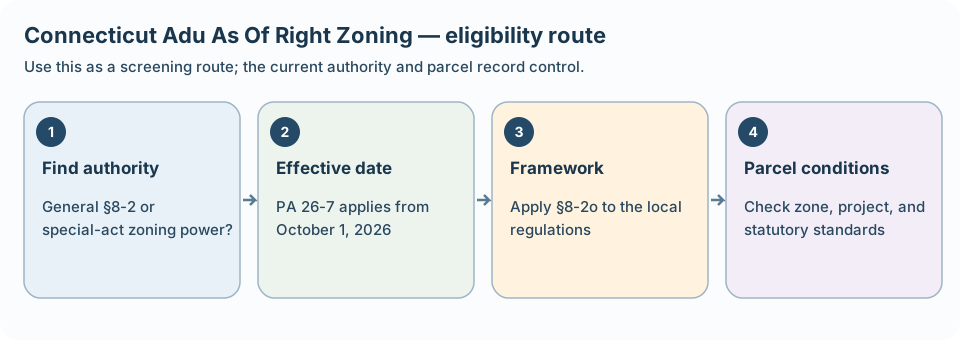
Connecticut Public Act 26-7 expanded the state’s as-of-right accessory dwelling unit (ADU) zoning framework to zoning regulations adopted under special-act authority. The change took effect October 1, 2026. The Connecticut General Assembly’s 2026 municipal-law summary describes the change as extending the ADU zoning requirements to special-act municipalities and making the framework apply statewide.
Identify which zoning authority governs the parcel
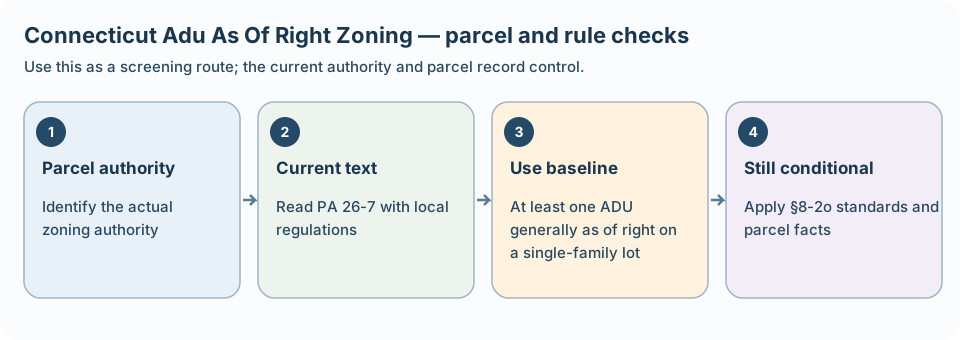
The law requires the ADU framework in regulations adopted under the general zoning statute, Conn. Gen. Stat. §8-2, and now regulations adopted under a special act. First determine which local authority and regulations control the property’s zoning. Older materials may use “accessory apartment,” the earlier statutory term; the Act updates statutory references to “accessory dwelling unit.”
Under §8-2o, the framework generally requires at least one ADU as of right on a lot containing a single-family dwelling, subject to the statute’s conditions and permitted local standards. The State-law framework does not answer the parcel’s zone, overlays, project form, permit status, or whether the proposal meets those conditions.
Check the current local rule and effective State text
Public Act 26-7 became effective October 1, 2026. The 2026 statutory supplement predates that effective date, so read the Act together with the current local regulation and the applicable version of §8-2o. This article describes the jurisdictional reach of the framework, not unconditional permission for every parcel.
The Act also changes utility-connection provisions, which are outside this eligibility screen. Confirm the parcel’s authority, current zone, and proposed form with the municipality before relying on the State framework.