Houston says the City does not have zoning. That does not establish whether a secondary dwelling can be built on a particular lot.
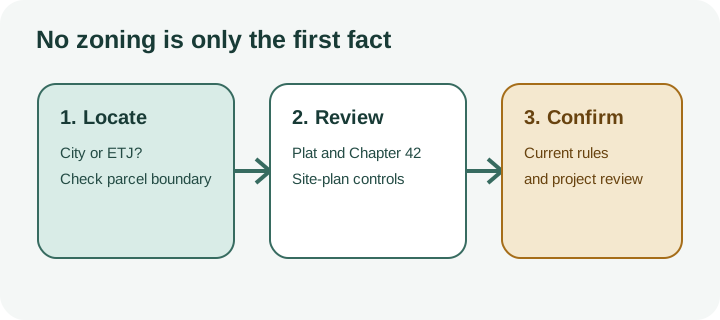
Check land development and the lot
The City says Chapter 42 governs subdivision and platting. Site-plan reviews can check parking, trees and shrubs, setbacks, and access. Its Planning and Development Department regulates land development in the City and its ETJ, but that does not show which rule applies to a specific parcel.
The Livable Places guide uses “second dwelling unit” for an additional dwelling on a single-family lot, above a garage or in a separate structure. Under the Chapter 42 definition added by Ordinance 2023-801, a lot with one dwelling in a free-standing building and a detached secondary unit no larger than 1,500 square feet is classified as single-family residential for that code. This is not an overall size limit or a parcel approval.
Use the right next check
Confirm whether the property is in the City or ETJ, review its plat and applicable Chapter 42 rules, and ask which land-development and site-plan requirements apply. Other City codes, building review, utilities, and private restrictions remain separate checks.
For the general authority and property workflow, see how to check whether an ADU can be built on a property. A zone table is only relevant where the authority actually uses zoning districts.