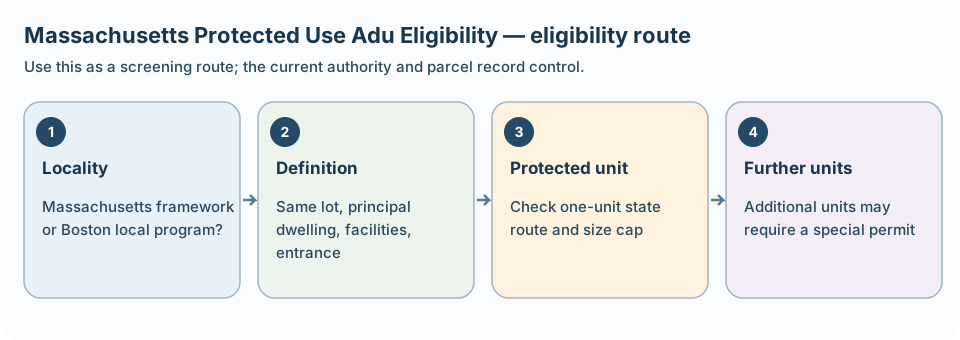
Massachusetts has a protected-use path for qualifying accessory dwelling units (ADUs) under M.G.L. c. 40A. That protection limits some local zoning barriers; it does not establish that a particular design or parcel is ready for a permit. The state FAQ says the Chapter 40A ADU law applies to 350 cities and towns. Boston is outside that framework and uses its own ADU rules.
Confirm that the project fits the state definition
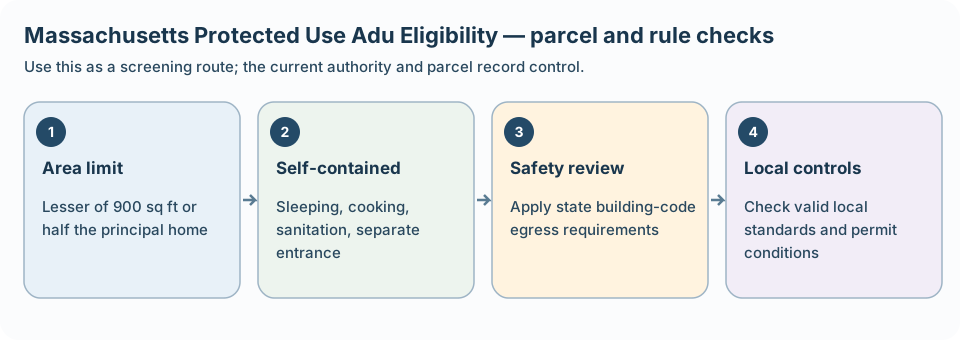
The state definition describes an ADU as a self-contained housing unit on the same lot as a principal dwelling, with sleeping, cooking, and sanitary facilities and a separate entrance that meets state building-code safe-egress requirements. Its gross floor area may not exceed one-half the principal dwelling’s gross floor area or 900 square feet, whichever is smaller. Check the current statute, the measured floor area, and the actual entrance arrangement.
The current state FAQ describes one Protected Use ADU on a lot with a principal dwelling, even where that dwelling is a multi-unit building or the lot contains more than one principal dwelling. A municipality may allow additional ADUs, but the state FAQ says those additional units require a special permit. That is a separate route from the one protected-use unit.
Identify which local zoning barriers are limited
In a single-family residential zoning district, the state law protects one qualifying ADU from being prohibited, unreasonably restricted, or made subject to a special permit or other discretionary zoning approval for the use. The current FAQ also says the protected-use path is not limited to lots containing only single-family homes. Conflicting local provisions are unenforceable for a Protected Use ADU.
The protection does not erase all local review. Reasonable dimensional rules, site-plan review, certain parking limits, and other state or local requirements may still apply. Confirm the municipality’s current zoning by-law, permit history, and the rules that remain valid for the proposed site and design. Building, fire, sanitary, and environmental approvals are separate; septic systems may trigger Title 5 review.
Check the current regulation and Boston’s separate route
The Commonwealth identifies 760 CMR 71.00, effective January 31, 2025, as the current ADU regulation. Mass.gov describes proposed amendments to that regulation, with public comments accepted from September 11 through October 9, 2026. That comment window has closed, but the page still labels the revisions as proposed. Check the current regulation and agency status before relying on any later amendment.
For a parcel-specific screen, identify the municipality and zone, confirm the proposed unit against the state definition and one-unit limit, check local rules that remain applicable, and verify structure status and separate approvals. Boston residents should use the City’s separate ADU eligibility guidance. This state guide does not decide whether an individual property qualifies.