Mesa’s City guidance describes a standard attached-and-detached combination and a narrower route for an additional detached ADU. The second route depends on lot size and a recorded affordability commitment, so it should not be read as a general three-unit allowance.
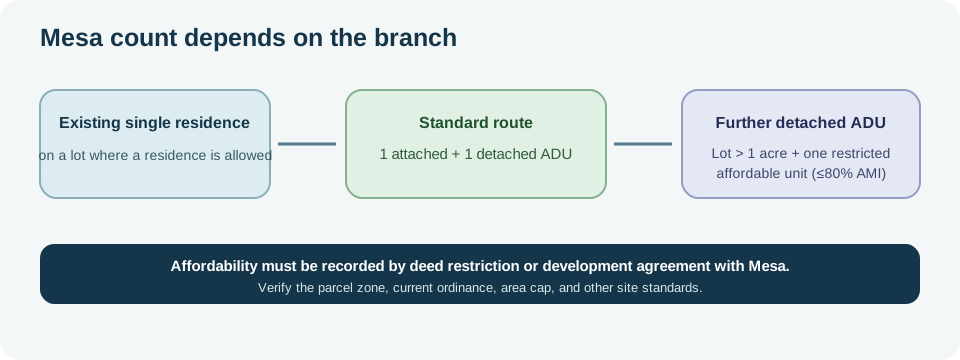
Start with a lot where a single residence is allowed
The City lists ADUs in Agricultural, Single Residence, Small Lot Single Residence, Multiple Residence, Downtown Residence, Mixed Use, Neighborhood Commercial, Limited Commercial, and General Commercial zones where a single residence is allowed. Check the actual zoning designation and the City’s current map; a zone name alone does not establish that a residence or ADU is permitted on a parcel.
For a property with an existing single residence, the City says one attached and one detached ADU are permitted. The City guide describes a maximum area of 1,000 square feet or 75% of the primary dwelling’s habitable floor area, whichever is less.
Use the separate route for another detached unit
The City describes an additional detached ADU only on a lot larger than one acre and only when at least one ADU on the property is restricted affordable for households earning up to 80% of area median income. The restriction must be in a deed restriction or development agreement with Mesa. Without both the acreage and affordability conditions, do not count on this extra detached-unit branch.
Check Mesa Zoning Ordinance section 11-31-3, the parcel map, any historic-district review, and the building-permit requirements. The City says no extra parking is required for the ADU, but the property must retain at least two spaces for the primary residence. This is a Citywide screen, not a parcel finding. Compare it with Phoenix’s ADU count and zoning screen or review the general lot and unit-count method.