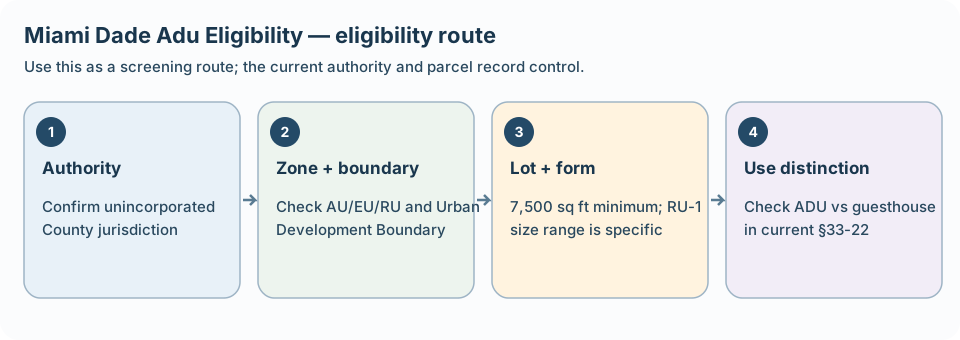
Miami-Dade County’s accessory dwelling unit (ADU) rules are a county screen. First confirm that the property is in unincorporated Miami-Dade County; cities within the county may have their own zoning authority. The County’s ADU and guesthouse guidance points property owners to the Land Management map and County Code §33-22.
Check the zoning district and lot
The County says one accessory unit is permitted on a lot developed with a principal single-family dwelling in AU, EU, and RU districts inside the Urban Development Boundary. A GU-zoned property may qualify when it is trended to AU, EU, or RU. The stated minimum lot area is 7,500 square feet. The County’s 400-to-800-square-foot unit range is specifically stated for RU-1, not every district.
Verify the zoning classification, Urban Development Boundary location, any GU trend designation, and lot area in the County’s current map and code. The County page is a screening summary; it does not establish that a parcel meets all of §33-22.
Do not treat an ADU as a guesthouse
The County distinguishes an ADU for a separate family of occupants from a guesthouse intended for occupants of the principal home and their family. County rules also distinguish how each type may be used. Confirm the unit’s intended classification before applying the right, count, and review path.
County guidance calls for administrative site-plan review, a Certificate of Use, and a building permit to construct or legalize an ADU. A detached unit may not be in front of the principal structure and remains subject to setbacks and other standards. Verify jurisdiction, current code, property status, and the full approval requirements with the County before relying on this screen.