Nevada AB 396, Chapter 365, requires certain local governments to adopt an accessory dwelling unit (ADU) ordinance for residential property. The law became effective July 1, 2026. It applies to cities with populations of at least 60,000 and counties with populations of at least 100,000, subject to a statutory exception for certain interstate-compact regional planning areas. Read the current enacted statute and check the local authority’s current code.
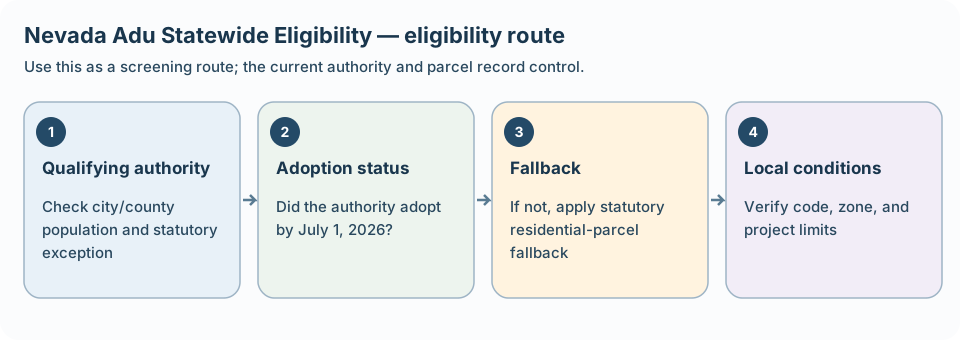
Check whether the local authority adopted a compliant ordinance
The deadline for a qualifying city or county to adopt a compliant ADU ordinance was July 1, 2026. AB 396 says that if a covered authority did not adopt an ordinance consistent with the law by that date, ADUs are authorized on parcels zoned for residential use under the statute’s fallback. The exact local status matters: confirm the authority’s population qualification, any applicable regional-planning exception, and its adopted ordinance or current fallback treatment.
The statute describes attached, detached, and interior ADUs on the same lot, a maximum count, and limits on specified local restrictions. Those provisions operate with the law’s definitions and conditions; they do not remove every site, zoning, or permit requirement.
Nevada’s statewide framework is not a parcel approval. Identify the city or county, the parcel’s residential zone, the current local ordinance and adoption status, and any project-specific limits before relying on the State law.