New York City’s “ADU for You” guide describes several ways to add an ancillary dwelling unit, but a citywide summary cannot decide a property. Start with the City’s address lookup and identify whether the proposal is a new backyard unit or a conversion. The Housing Preservation and Development guide is a screening tool; the Department of Buildings (DOB) supplies the current filing and rule-status information.
Check the residence and basic ADU screen
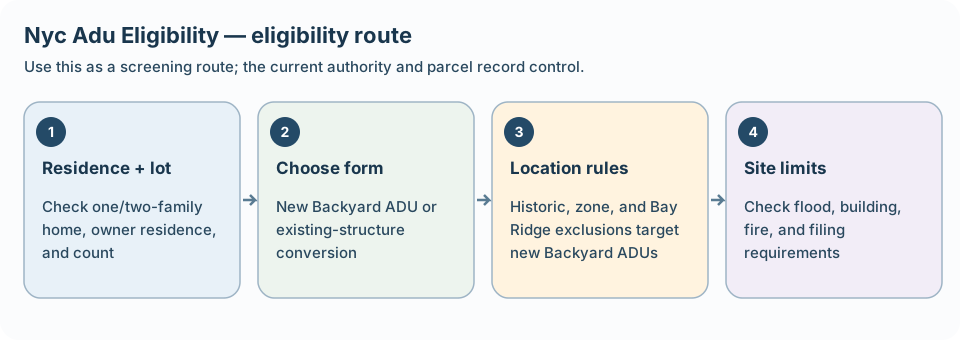
DOB’s current summary allows one ADU per one- or two-family residence. At the time of initial occupancy, the zoning lot must be the primary residence of an owner. An ADU may have no more than 800 square feet of zoning floor area and needs a separate entrance. A two-family building that adds an attic, basement, cellar, or attached ADU may be treated as a three-family building under the New York State Multiple Dwelling Law unless the unit is separated by a fire wall. Confirm the project’s classification with a New York State registered design professional and DOB.
Separate new Backyard ADUs from existing-structure conversions
DOB says a new Backyard ADU is not permitted in designated historic districts, in R1-2A, R2A, and R3A districts outside the Greater Transit Zone, or in specified parts of the Special Bay Ridge District. A conversion of an existing garage is not classified as a Backyard ADU for those location restrictions. That distinction does not waive other zoning, building, fire, or permit requirements for a conversion.
Use the official zoning and historic-status tools to screen the address. A proposed backyard structure, attached unit, attic, basement, cellar, or garage conversion can follow a different set of rules, so have the project’s exact location and existing conditions reviewed before relying on a general eligibility result.
Check flood restrictions and cellar filing status
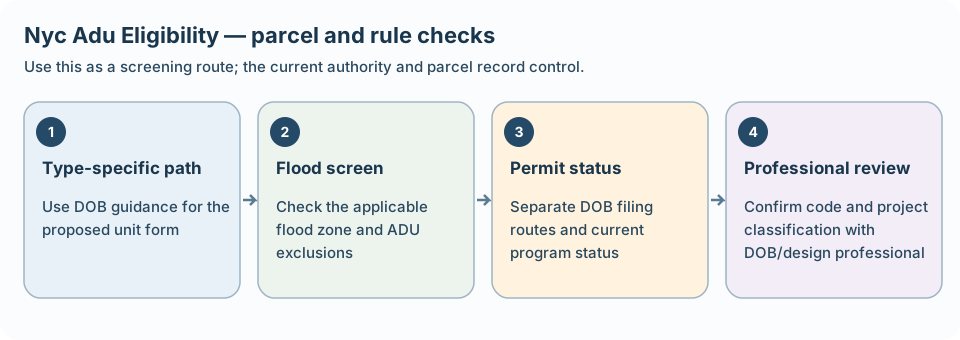
Subgrade ADUs are not permitted in the high-risk flood areas listed by DOB: FEMA’s Special Flood Hazard Area, the Coastal Flood Risk Area, and the Department of Environmental Protection’s 10-Year Rainfall Flood Risk Area. Check the current official maps for the property; do not infer eligibility from a neighborhood address or an older guidebook.
As of DOB’s page revision dated April 9, 2026, Local Law 126’s pilot for certain already-occupied basement and cellar units was not accepting applications while DOB rules were pending. The pilot is limited to existing one- and two-family buildings in designated community districts, units that existed before April 20, 2024, and owner applications before April 20, 2029. DOB separately says it accepts applications for a one-family home constructed with a cellar ADU under 1 RCNY §105-08(d)(4) and Local Law 80 of 2026. The same page prints an apparent effective-date error, “April 9, 2006,” beside that 2026 law; confirm the operative date and route directly with DOB.
The City directs ADU filings through DOB NOW: Build. A lookup result or agency overview is not a permit or a determination that a particular cellar, garage, or rear-yard proposal qualifies.