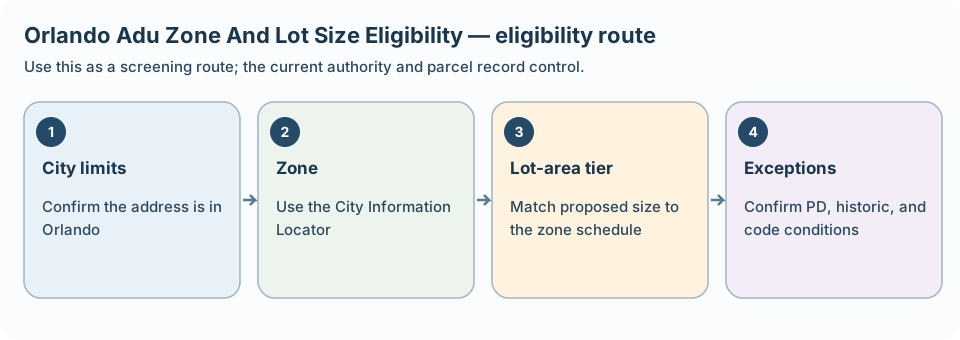
Orlando’s ADU guide says to confirm two things before applying its zone rules: the address must be within City of Orlando limits, and the parcel’s zoning category must be identified in the City’s Information Locator. The City’s step-by-step guide lists R-1, R-2, R-3, MXD, O, and PD categories as possible ADU zones, subject to lot area and additional code standards.
Compare the zone and lot area
The City’s table provides different minimum lot areas for ADUs up to 500 square feet and, in some zones, up to 1,000 square feet. For example, an R-1 parcel needs at least 6,000 square feet for the up-to-500-square-foot tier and 9,000 square feet for the up-to-1,000-square-foot tier; R-1A lists 7,700 and 11,550 square feet, respectively. The guide says the ADU must be smaller than the main dwelling and that floor-area ratio may further limit what fits.
Not every zone has a 1,000-square-foot tier. The full current guide lists the applicable schedule, and the code may impose tandem or duplex standards above 500 square feet in some districts. A planned-development result needs direct City Planning confirmation; a Lake Nona PD has a separate one-ADU, 1,000-square-foot rule that is not limited by lot size, while remaining subject to planning standards.
Check historic and parcel conditions
The City says an ADU in a historic district is limited to 700 square feet and requires Major Review for a Certificate of Appropriateness before building-permit application. Verify the historic designation and current code process. The City guide is a screening tool; the Information Locator, parcel area, PD documents, current code, and City review determine the actual route.