San Francisco implements California’s State Accessory Dwelling Unit Program through local code and review. The Planning Department’s current Planning Director Bulletin No. 3 is an overview, not a parcel approval. The bulletin was updated in 2026; check its current text and the linked Planning Code before applying it to a project.
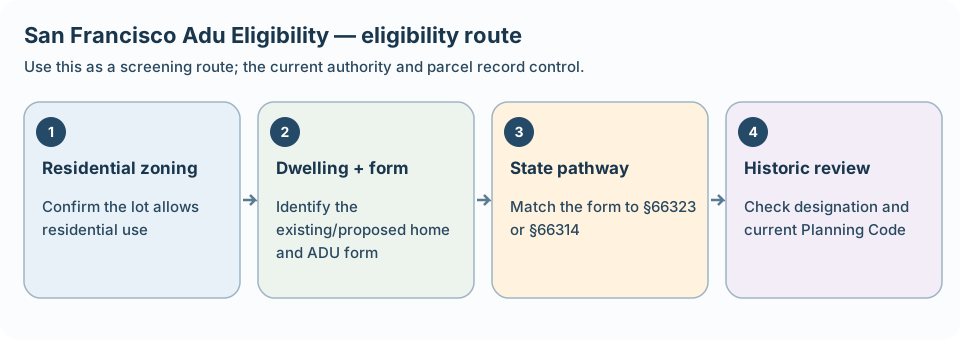
Start with the lot and primary dwelling
The bulletin says a lot must be in a zoning district that allows residential use, including single-family or multifamily use, and must contain an existing or proposed dwelling. Use the City’s Property Information Map to identify the parcel’s zoning district. A street address alone does not establish the zoning lot or the type of dwelling recognized by the City.
The City describes several ADU forms, including converted, attached, detached, and junior units. Their eligibility rules differ, and the bulletin separates streamlined units under California Government Code §66323 from other State ADUs under §66314. Identify the proposed form and the existing or proposed primary dwelling before using a count or combination rule.
Check historic-resource status
For an ADU proposed under Government Code §66314, San Francisco requires consistency with standards intended to prevent adverse effects when the property is listed in the California Register or designated individually or as part of a historic or conservation district under Planning Code Articles 10 or 11. This qualification applies to the specified state-law pathway; historic status does not, by itself, answer every other zoning or permit question.
Confirm the property’s designation, current map result, applicable State or local program, and current Planning Code with the City. The bulletin summarizes multiple programs and does not determine whether a particular lot or design qualifies.