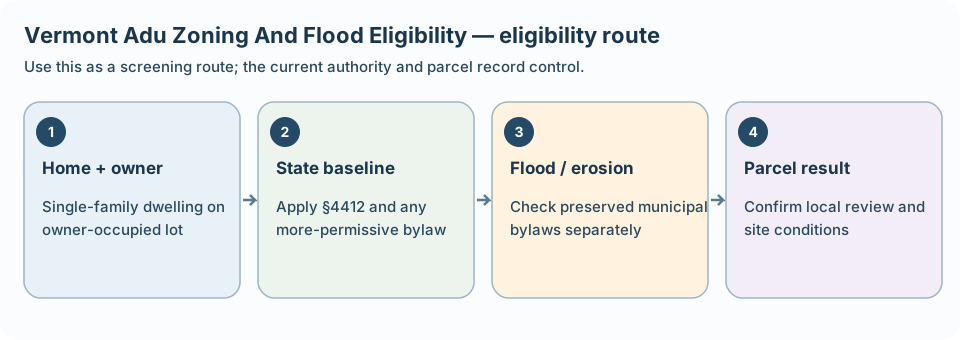
Vermont law requires municipalities to allow one accessory dwelling unit within or appurtenant to a single-family dwelling on an owner-occupied lot. The current 24 V.S.A. §4412 preserves municipal flood-hazard and fluvial-erosion bylaws, so the statewide allowance does not decide every site.
Check the owner-occupied home and local rules
The statute says the ADU is generally subject to the same review and dimensional or other controls as a single-family dwelling without an ADU, although a local bylaw may be more permissive. It also includes a specific rule for conversion of an existing detached nonresidential building: the criteria may not be more restrictive than those used for a single-family dwelling without an ADU.
Confirm the parcel’s current municipal bylaw, the owner-occupied dwelling status, the proposed form, and any additional local permission. Vermont’s statutory minimum is not a finding that a specific site or design qualifies.
Check flood and erosion designations separately
Flood-hazard and fluvial-erosion bylaws are expressly preserved. Use the current official maps and the applicable municipal rules to determine whether they affect the lot or proposed building. A zoning permission does not remove a separate flood review or building approval.
For a parcel-level answer, verify the current statute, bylaw, parcel mapping, owner status, and project details with the municipality.