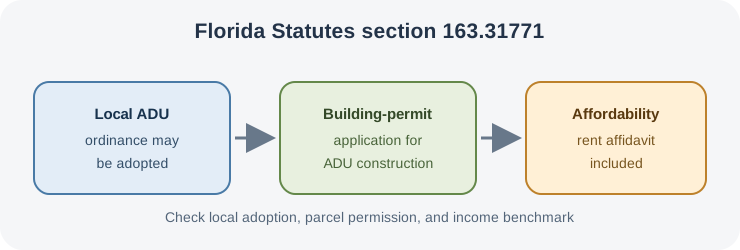
Florida Statutes section 163.31771 creates a local ADU ordinance pathway that includes an affordability condition. The statute says a county or municipality may adopt an ordinance allowing accessory dwelling units in areas zoned for single-family residential use. It defines an ADU as a secondary living unit with separate kitchen, bathroom, and sleeping area, either within the primary structure or on the same lot.
The permit affidavit
Section 163.31771 requires an applicant for a building permit to construct an ADU to include an affidavit stating that the unit will be rented at an affordable rate to an extremely-low-, very-low-, low-, or moderate-income person or household. The statute defines affordability using monthly rent and utilities and a 30-percent measure tied to median adjusted gross annual income for those groups.
The statute does not provide a parcel-specific rent ceiling in the language summarized here. Do not calculate a rent cap from this page alone; confirm the applicable income benchmark and documentation with the responsible local government.
Local permission still matters
The statute authorizes a local ordinance; it does not show that every city or county has adopted one or that every parcel qualifies. Check the current county or municipal ordinance, the property’s zoning, and the building-permit application before relying on the affidavit pathway. Other approval and occupancy conditions may also apply.
Read the current Florida statute and ask the local government how it administers section 163.31771.
Key points
- The state statute gives local governments an optional ordinance pathway for ADUs.
- Its building-permit application includes an affordability affidavit.
- State language does not determine local adoption, site eligibility, or the exact rent threshold.