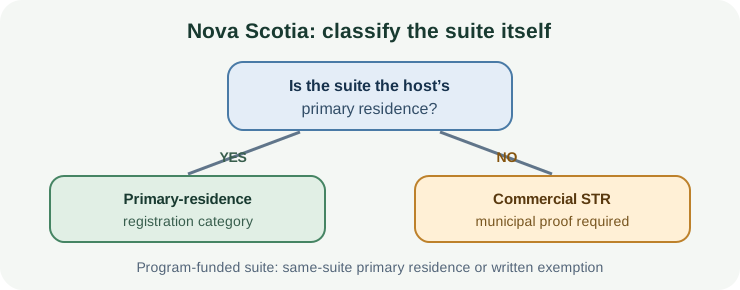
Nova Scotia treats a stay of 28 consecutive days or less as a short-term rental. Under the provincial regulations, a secondary or backyard suite is classified as a commercial short-term rental unless the suite itself is the host’s primary residence. Living in the main house does not make the separate suite a primary-residence rental.
The suite’s residence status matters
The regulations distinguish a short-term rental in a suite that is the host’s primary residence from one in a separate unit. The classification affects registration. Commercial operators must provide municipal land-use compliance information and register each address with the provincial registry. Registration renews annually and does not replace local land-use or building approval; see the Province’s registration instructions.
Program-funded suites have an additional condition
An owner or occupant who received funding through the Secondary and Backyard Suite Incentive Program cannot operate or register the suite as a short-term rental unless that suite is their primary residence or the Minister provides a written exemption. The regulation allows an exemption where program terms have been met or the Minister determines one is in the public interest. Check the executed funding agreement as well as the current regulation.
The Province marks its online consolidation unofficial and warns of frequent amendments; verify the latest filed text and municipal requirements.
Key points
- The suite itself must be the host’s primary residence to use the primary-residence classification.
- Funding can add a separate restriction even where the provincial registration route is otherwise available.
- Provincial registration and municipal permission answer different questions.