Toronto’s short-term-rental rules apply to the dwelling unit being offered. A stay of fewer than 28 consecutive days is a short-term rental, and the operator must use the rented unit as their principal residence. Living in the main house does not make a separate suite on the same lot the operator’s principal residence.
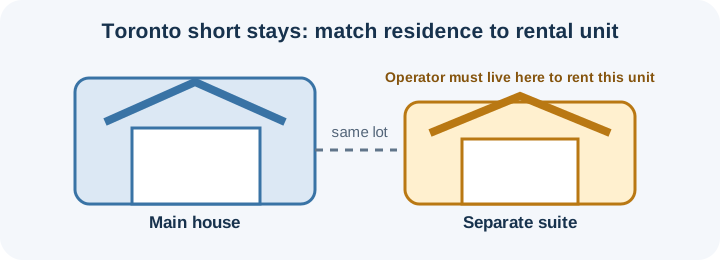
The suite itself must be home
The City says a secondary suite can be rented short term only if it is the operator’s principal residence. Its guidance applies the same unit-specific test to laneway and garden suites: the operator must be the principal resident of that suite. If an operator lives in the main dwelling, that fact alone does not qualify another self-contained unit on the property.
The City also says a secondary suite must be permitted by zoning bylaws and comply with building and fire requirements. A short-term-rental registration does not establish that a suite is legally built or approved for occupancy. Check the unit’s approval record and the rules for its exact address before applying.
Registration and nights
Operators must register with the City and renew their registration annually. The City’s 180-night annual limit applies to an entire house rented as a whole unit; room rentals have different conditions. Do not transfer those limits to a separate suite without checking the current operator rules for the unit and registration type.
The City’s operator guidance explains registration, unit definitions, night limits, and eligibility. Confirm current requirements before advertising.
Key points
- The principal-residence test follows the specific suite being rented.
- A resident of the main house cannot rely on that residence to qualify a different suite.
- Registration, zoning permission, and building and fire compliance are separate checks.