Whistler’s zoning bylaw uses the term auxiliary residential dwelling unit. The conditions are zone-specific. The RS7 rule limits who may occupy the unit; the RS-E2 rule offers a larger unit only with a registered employee-housing covenant. These examples do not establish what is allowed on a particular parcel.
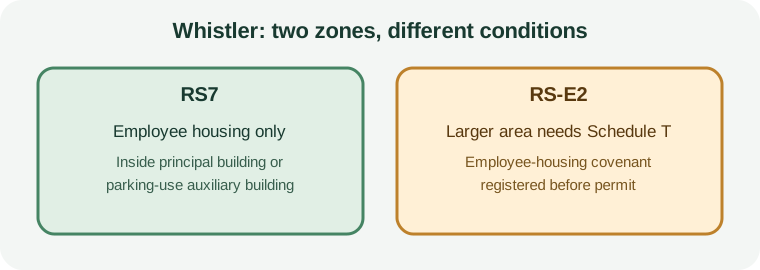
RS7: employee housing only
In RS7, the bylaw allows an auxiliary residential dwelling unit inside the principal residential building or in an auxiliary building that also contains parking use. The unit must be occupied only as employee housing. The bylaw separately defines permitted uses, so confirm the current employee-housing definition and applicable occupancy terms rather than assuming any worker or tenant qualifies.
RS-E2: the covenant changes the area allowance
RS-E2 allows one auxiliary residential dwelling unit inside the principal residential building or an auxiliary building also used for parking. The bylaw sets an ordinary floor-area range and a 35 percent cap relative to the detached dwelling. It permits a larger maximum for a unit restricted to employee housing by a covenant in the form of Schedule T; the 35 percent cap still applies.
A covenant under this provision must be registered before the building permit, or before a development permit where one is required. The registered document and the parcel’s zone matter. Do not treat this provision as a general Whistler-wide allowance or as permission for tourist accommodation.
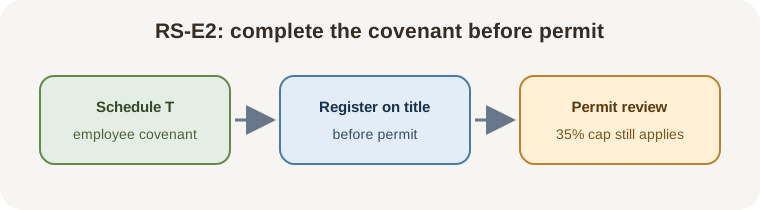
What to verify
Use the Municipality’s current zoning map and bylaw for the property, confirm whether the lot is RS7 or RS-E2, and ask the Resort Municipality to confirm the current Schedule T and employee-housing requirements. The RS7 and RS-E2 bylaw sections describe different conditions.
Key points
- RS7 limits unit occupancy to employee housing.
- RS-E2’s larger-area route requires the prescribed registered covenant before permit issuance.
- A unit’s zone and recorded covenant are essential to the answer.