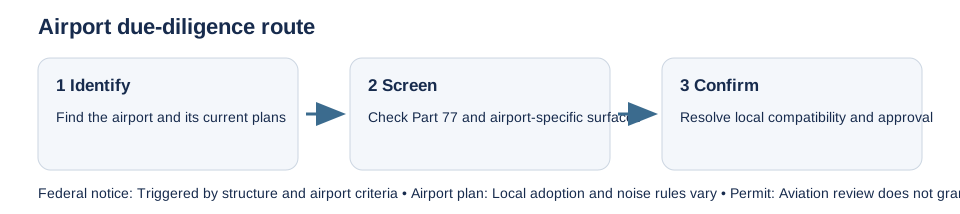
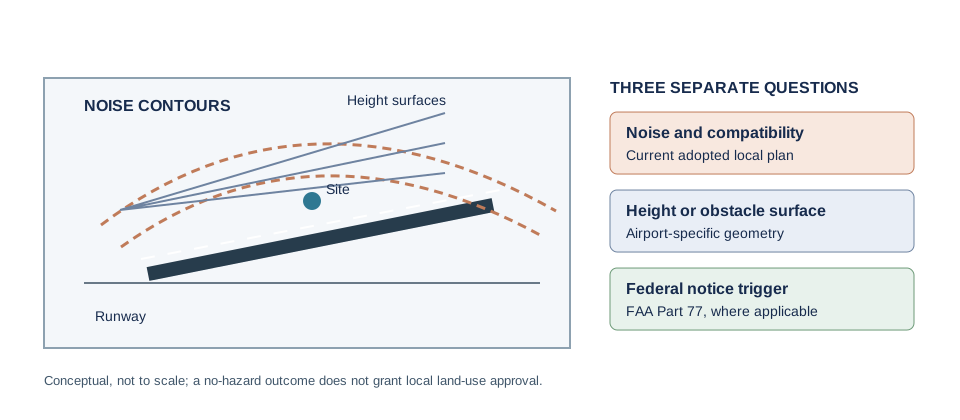
Airport review is airport-specific. A generic radius does not determine whether a structure needs aviation notice, conflicts with a local compatibility plan, or lies in an airport zoning area. Identify the nearby airport or heliport and check the current airport master plan, adopted local land-use plan, noise contours, and any height or safety surfaces.
In the United States, federal Part 77 notice is separate from local land-use approval. If 14 CFR §77.9 requires notice, §77.7 requires Form 7460-1 at least 45 days before the proposed construction or alteration starts, or before a construction-permit application is filed, whichever is earlier. The FAA Central Region explainer uses working-day wording, so confirm the filing trigger and practical lead time with FAA OE/AAA rather than relying on a generic airport radius. The notice trigger depends on the structure and its relationship to an airport or heliport. A no-hazard determination does not grant local permission.
State and local compatibility rules can add separate review. California airport land-use compatibility plans, Washington airport planning law, Ontario planning policy, and Canadian airport-specific zoning regulations have different scope and adoption. Noise, airspace notice, obstruction protection, and land-use compatibility are related but distinct questions.
Describe the highest point, temporary equipment, cranes, site location, and proposed schedule accurately. Ask the airport or planning authority which adopted surface and noise plan applies, and ask FAA or Transport Canada about federal notice or zoning when relevant. Do not treat a map or notice outcome as a building permit or a noise assessment.