Belfast treats accommodation as ancillary when it is subordinate to, supplementary to, and dependent on the main home. A self-contained unit may be a separate dwelling; calling it an “annexe” does not decide the route.
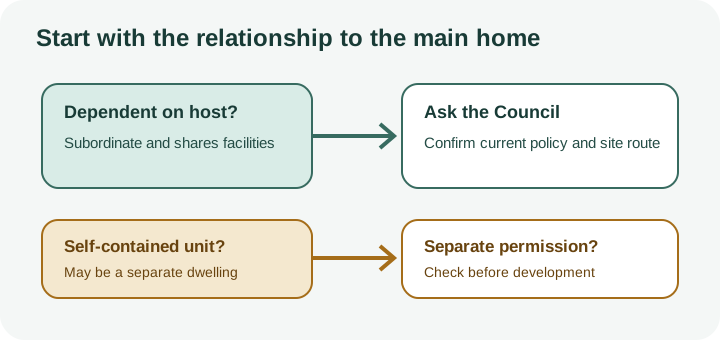
Check the relationship to the main home
Belfast City’s May 2023 guidance describes ancillary accommodation as limited, dependent on the main home, and sharing facilities such as its kitchen.
The Council formally adopted its Local Development Plan Strategy on May 2, 2023. Its Policy RD2 covers residential extensions and alterations; the non-statutory supplementary guidance explains how RD2 applies to ancillary buildings. Each application is assessed on its site and merits.
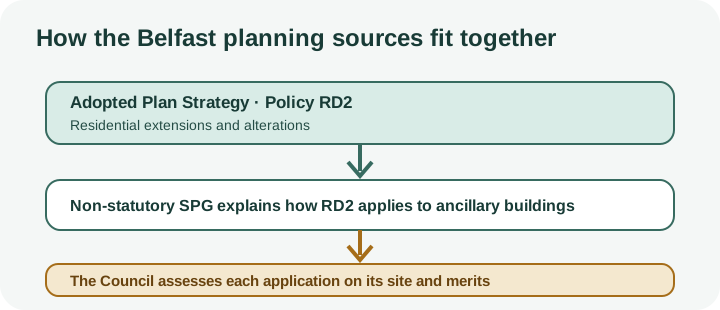
A separate dwelling needs its own planning route
The SPG says a self-contained building in a home’s curtilage is not ancillary unless a separate dwelling could receive planning permission. Northern Ireland guidance lists examples needing permission: dividing a house into a separate home, using a garden building as another person’s residence, or building a separate garden house. The examples are not exhaustive.
Before work starts, ask the Council whether the proposal is ancillary or a separate dwelling, and what application or confirmation is needed. Check planning history and designated-area controls; building regulations are separate.
For the wider property screen, see how to check whether an ADU can be built on a property and how project form affects eligibility.