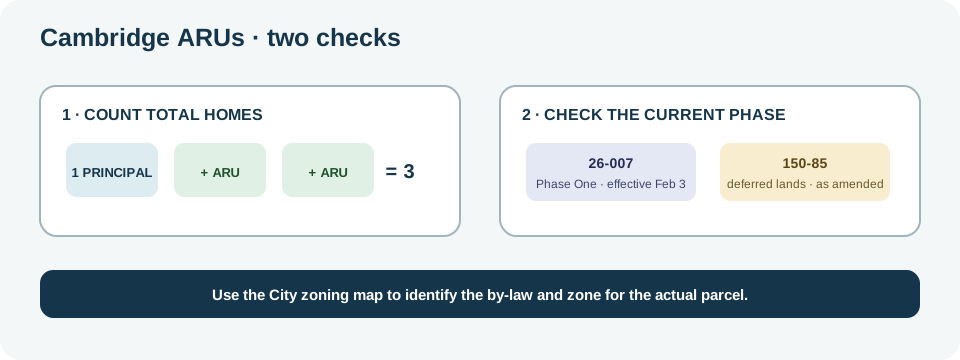
Cambridge’s City guidance describes a route for up to two additional residential units (ARUs) on a qualifying lot, for three total homes. Two separate checks matter: count all units on the property, and find which zoning by-law currently governs the address.
Count the units, not just the additions
The City says an individual lot containing a single detached, semi-detached, or townhouse dwelling may contain up to two ARUs. Its examples allow either up to two units within the main residential building plus one in a detached accessory structure, or up to three units within the main building. That is a maximum of three total homes, not three additional units.
ARUs are self-contained and may be internal, attached, or detached. The City summary identifies Zoning By-law 26-007, section 4.19, for setbacks, parking, access, and entrances.
Check which zoning by-law applies
Cambridge’s zoning page says Phase One of Comprehensive Zoning By-law 26-007 took effect on February 3, 2026 and regulates certain residential lands. Other land, including residential lands deferred from Phase One, remains under By-law 150-85 as amended. The City directs property owners to check the interactive zoning map before applying for a permit.
Use that map to identify the parcel and governing by-law phase, then confirm the current zone and ARU provisions with Planning. The Citywide count summary does not establish a lot’s zoning phase, site fit, or approval. Building permits, Ontario Building Code compliance, and City occupancy approval are separate checks.
For another Ontario total-unit screen, see Kitchener’s four-unit eligibility route and the general lot and unit-count method.