New York City’s Local Law 126 pilot is a narrow route for some existing, occupied basement and cellar apartments. As of October 20, 2026, the Department of Buildings (DOB) says it is not accepting applications for an Authorization for Temporary Residence (ATR) while the program rules are pending. Meeting the stated criteria does not let an owner apply now or establish that a particular unit is legal or safe to occupy.
Check whether the unit is within the pilot’s stated scope
DOB describes the pilot for existing occupied basement or cellar units in one- or two-family buildings in designated community districts. The FAQ says a unit must have been occupied before April 20, 2024, be in the program area, contain acceptable kitchen and sanitation facilities, and be assessed by City agencies as eligible. DOB’s overview page uses different wording for the date test: it says the unit must have existed before April 20, 2024. Because the two official pages differ, confirm with DOB how the date test applies before relying on it. The City’s guidance also identifies specified high-risk flood areas as a restriction. Because the official pages use different terms, a construction-completion date alone is not a definitive eligibility answer; confirm the applicable test with DOB.
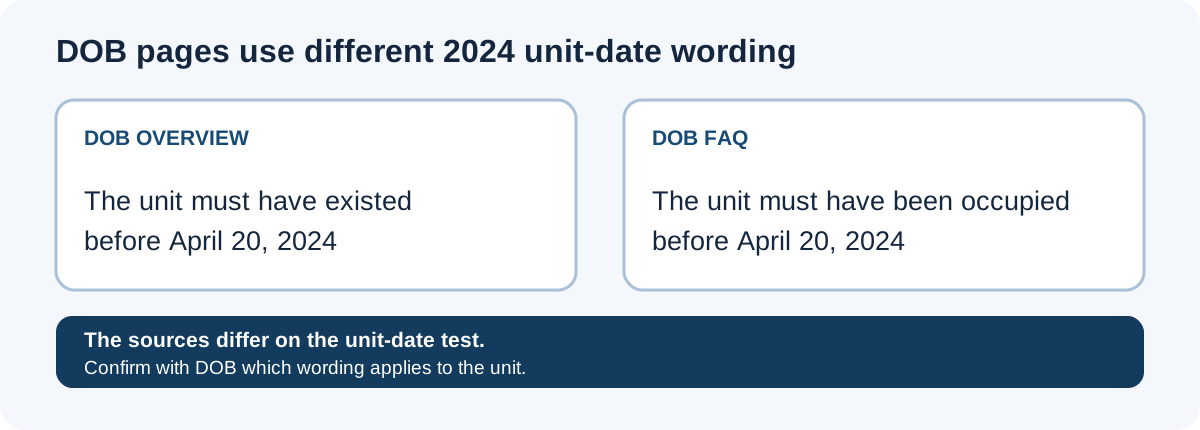
The two DOB pages differ on the 2024 unit-date test. The owner’s filing deadline is a separate question, described below.
The listed districts are Bronx 9–12; Brooklyn 4, 10, 11, and 17; Manhattan 2, 3, and 9–12; and Queens 2. These location, building, unit-date, and facility checks are screening conditions, not an eligibility decision for an address. Confirm the current maps and program rules with DOB.
Check the owner’s filing deadline separately
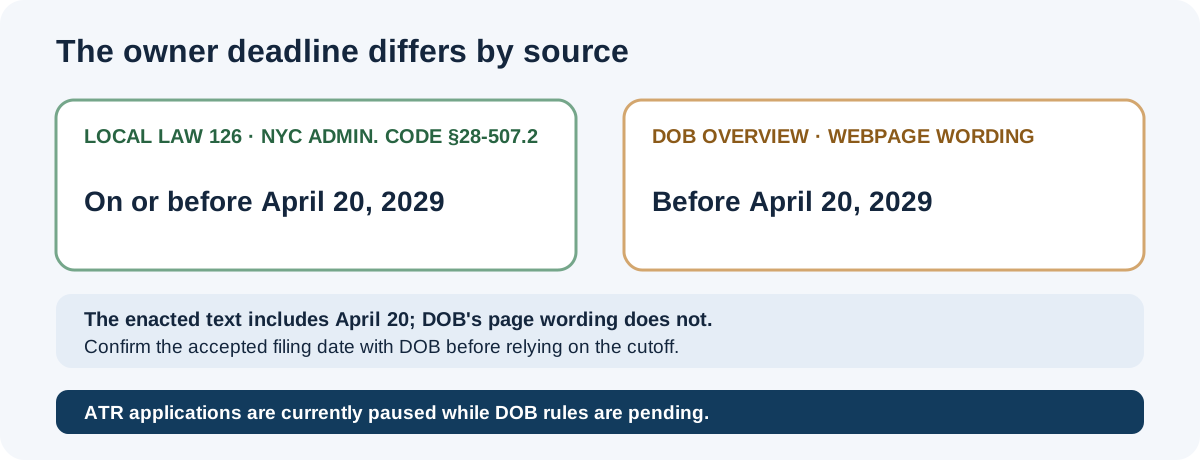
Local Law 126 of 2024 added NYC Administrative Code § 28-507.2, which says an owner must apply for an ATR on or before April 20, 2029. Section 28-507.14 repeats that the owner must apply “not later than” April 20, 2029. The current DOB overview page instead says an owner must apply before April 20, 2029. The statutory text includes an application on April 20; the webpage wording does not. Confirm with DOB how it will treat a filing on that date before relying on the cutoff. The City currently says ATR applications are paused while its rules are pending, so the future deadline does not mean the route is open now.
Understand the current application status
DOB’s current ADU page and ADU FAQ say ATR applications are not yet being accepted. The FAQ says DOB expects to announce when filing becomes available through DOB NOW. Until that changes, the pilot is not an open legalization application route. The same ADU page separately mentions filings for a one-family home with a cellar ADU under another rule; that note does not say the Local Law 126 pilot has opened. Ask DOB which current filing, if any, applies to the property.
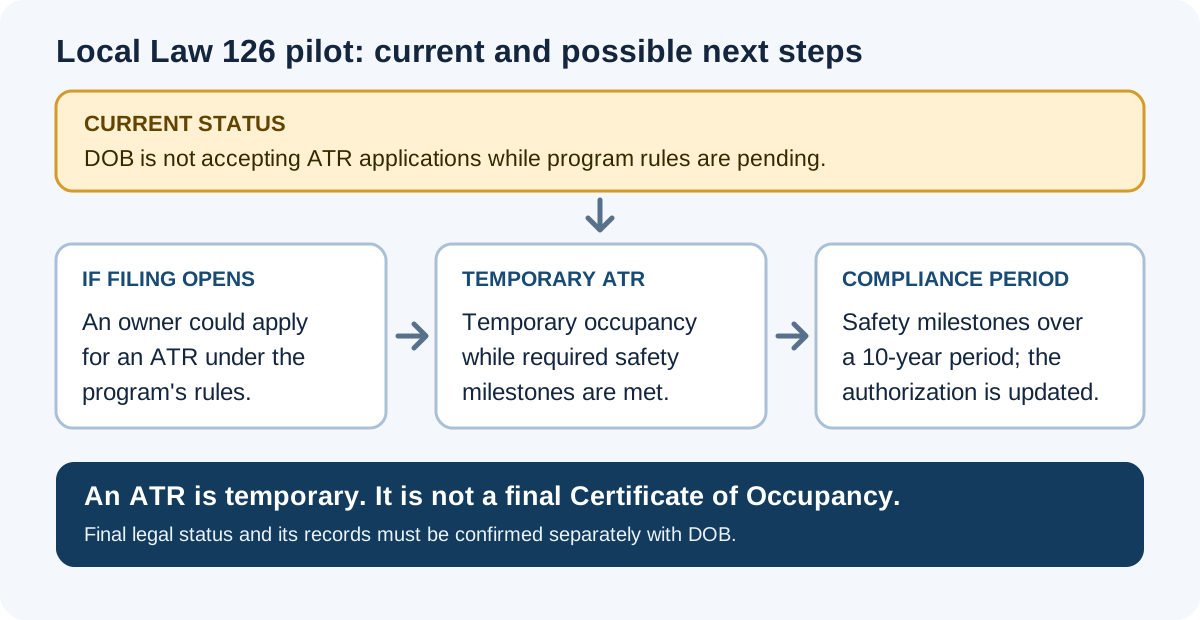
An ATR is temporary, not a final Certificate of Occupancy
If the program becomes available and DOB issues an ATR, the City’s FAQ describes temporary occupancy before a final Certificate of Occupancy while the unit meets safety milestones during a 10-year compliance period. The authorization must be updated as milestones are met. DOB says an ATR may be revoked and enforcement, including a vacate order, may resume if deadlines are missed. A temporary authorization and a final Certificate of Occupancy have different purposes and scopes.
Do not infer that an existing basement or cellar unit may be occupied because a future route is described. Confirm its current permit and occupancy record, applicable fire and building requirements, flood-area status, and any notices directly with the responsible City offices. For the wider correction process, see how New York City handles an illegal dwelling conversion and how to compare completion and legal-status records.