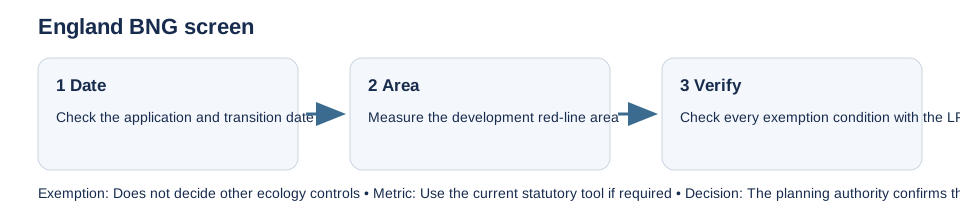
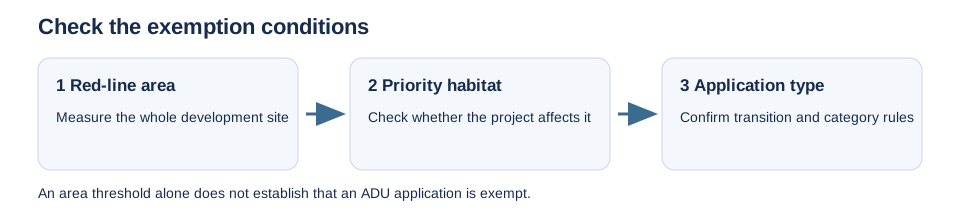
Biodiversity net gain (BNG) is an England planning requirement with dated exemptions. From 6 August 2026, the exemption for applications covering a development site of 0.2 hectares or below uses the site area inside the red-line boundary, not just the ADU footprint. If the proposal affects an on-site priority habitat, that exemption does not apply. The current guidance also says the self-build and custom-build exemption no longer applies to new applications made on or after 6 August 2026. Check the separate householder, de minimis, temporary-development, and transition rules; ask the local planning authority whether a separate ADU qualifies for any category.
If no exemption applies, the applicant generally needs the statutory biodiversity metric and must follow the current BNG process. The July 2026 guidance also says certain small developments can consider on-site and off-site delivery options together from 6 August 2026. Application timing and transition rules matter, so keep the submission date and red-line plan with the exemption check.
An exemption from BNG does not remove other planning, protected-site, protected-species, tree, or environmental duties. Nor does a metric result decide whether the proposed layout is acceptable under local planning policy. Ask the local planning authority which application and habitat baseline apply, whether an exemption statement is needed, and what records it expects.
Do not treat a small outbuilding as automatically exempt based only on its footprint. Check the current page and legislation for all applicable conditions, then record the authority’s response. Separate nature-site consent and protected-species routes are described in the UK nature-site guide.