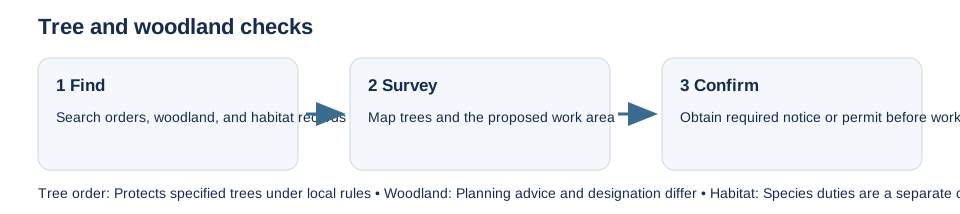
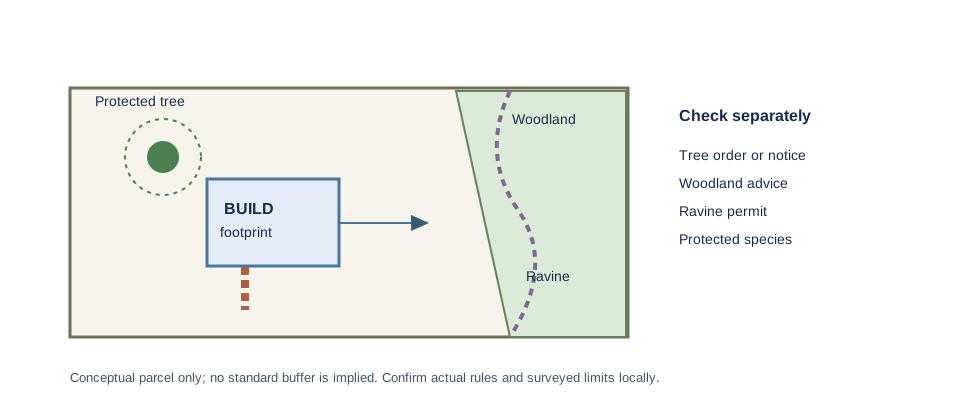
Before clearing, pruning, access work, or excavation, check whether trees or nearby habitat have their own legal controls. A tree symbol on a map may identify a record lead, but the specific order, notice rule, woodland advice, and local permit boundary need separate confirmation.
In England, ask the local planning authority whether trees on or affecting the site are covered by a Tree Preservation Order. Work on trees in a conservation area can require advance notice even without an order. Ancient woodland, ancient or veteran trees, and protected species such as bats have distinct planning considerations; a tree-order search does not answer those questions.
Other jurisdictions use different controls. Toronto, for example, has separate tree and ravine permit routes, with applicability tied to local by-laws and mapped features. Scotland’s woodland survey information can help identify potential ancient woodland, but a score alone does not prove a woodland’s origin. Check the authority responsible for the actual location and do not reuse a British threshold elsewhere.
Show the authority the parcel, tree locations, access, building footprint, drainage, and ground works. Ask whether a tree survey, arboricultural method statement, habitat survey, notice, consent, or local permit is needed before works. Preserve the authority reply and survey dates. A nature designation or species assessment may still be needed separately; see the UK protected-site and species guide.