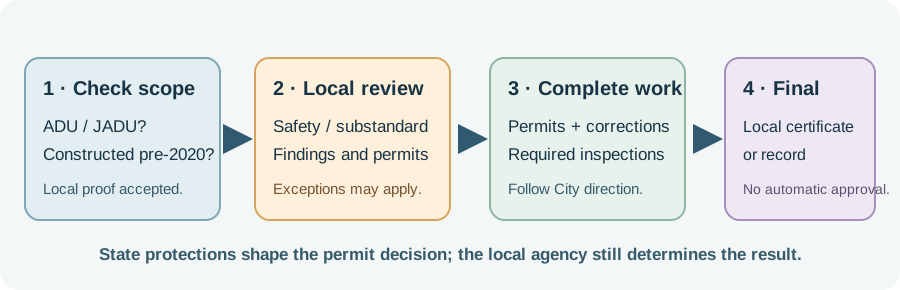
California’s state law and a city amnesty program answer related but different questions. The state’s current ADU Handbook describes protections for qualifying unpermitted ADUs and JADUs constructed before January 1, 2020. It limits when a local agency may deny a permit solely because of specified building-standard or ADU-rule violations, while preserving health-and-safety and substandard-building findings. It does not issue a permit, certify a unit, or decide that a dwelling may be occupied.
Confirm the state-law route with the local agency
The 2026 Handbook describes a local checklist for conditions that could make a building substandard. It also says a homeowner may obtain a confidential inspection from a licensed contractor before applying. After application, the local agency determines whether the unit fits the law, what permits and corrections are required, and which inspections and final records apply. A date record or private inspection is not a City approval. The MTC/ABAG implementation memo also flags an unresolved interaction with Health and Safety Code section 17980.12; get the current local interpretation where that issue affects a case.
Local certificates can mean different things
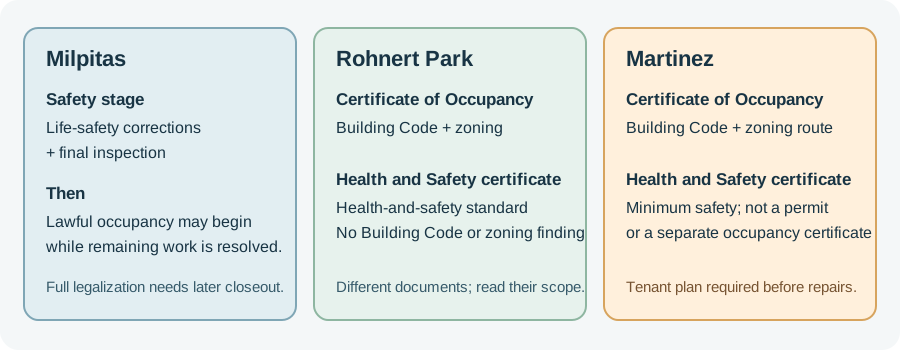
Local programs can set out different dates, sequences, and documents. Milpitas’s Safe ADU Legalization Program lists a pre-2020 date test and site conditions. Under its five-year delay track, after required life-safety corrections and final inspection, an eligible unit may be occupied while remaining code violations are addressed; full legalization comes after the later permit, work, and final inspection. Rohnert Park’s amnesty program also requires proof of a pre-2020 unit and offers a Certificate of Occupancy path with Building Code and zoning review, plus a Certificate of Health and Safety Compliance path that its page says does not establish Building Code or zoning compliance. Martinez’s Chapter 15.55 covers certain units constructed or converted before January 1, 2025 and separates a Certificate of Occupancy from a minimum-safety certificate; the latter is not a building permit or separate Certificate of Occupancy. The ordinance requires a tenant habitability and relocation plan before corrective repairs.
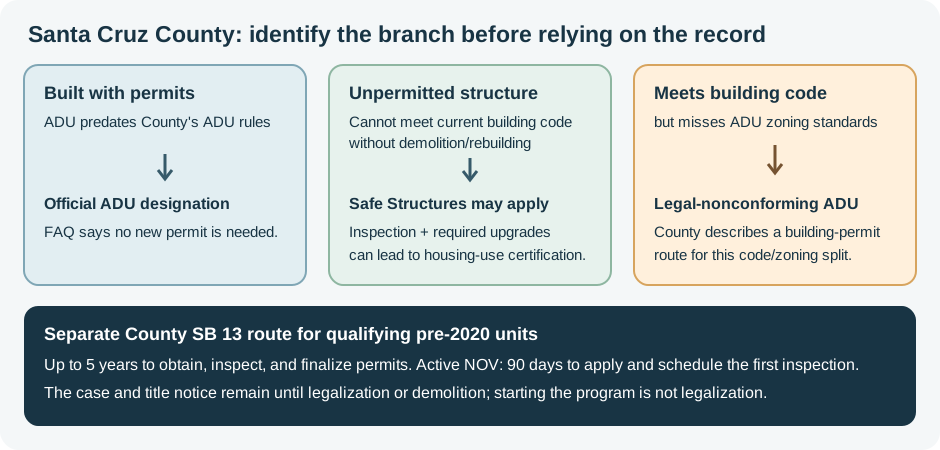
Santa Cruz County illustrates additional local branches. Its ADU FAQ says a permitted ADU built before the County’s ADU ordinance can be designated without a new permit. For an unpermitted structure that cannot meet current building code without demolition and rebuilding, the County’s Safe Structures Program may issue a housing-use certificate after a health-and-safety inspection and any required upgrades. If the structure can meet building code but misses ADU zoning standards, the County describes a legal-nonconforming permit route. Separately, a qualifying pre-2020 unit may enter the County’s SB 13 program to obtain, inspect, and finalize permits within five years. An active Notice of Violation has a 90-day application and first-inspection scheduling window; the code case and title notice remain open until legalization or demolition, and initial program steps do not legalize the structure. These are County-specific routes with different eligibility and endpoints.
These examples are local program rules, not interchangeable versions of AB 2533. A certificate’s name does not tell you its scope: read its issuing authority, required standard, inspections, limitations, and any continuing conditions. For other local routes, see the Berkeley pathway comparison, San José guide, Oakland guide, and Hayward guide.
Before relying on a pathway, ask the responsible city or county which rule applies to the unit’s construction or conversion date, whether it is an ADU or JADU, what proof it accepts, what safety review remains, and which record will mark completion. For a separate process on proving an old date, see construction-date evidence. A permit or limited safety document does not automatically resolve planning, occupancy, rental, or current-condition questions.