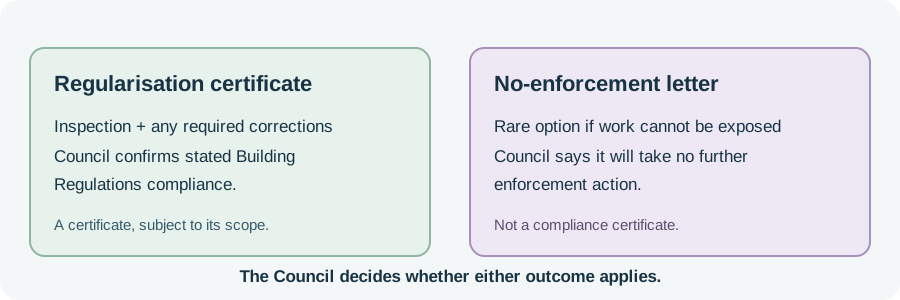
Carmarthenshire County Council describes two different outcomes for building work carried out without prior Building Regulations approval. The regularisation route is an application, inspection, and correction process. A no-further-enforcement letter is described only as a rare alternative when the work cannot be exposed for inspection. Neither document by itself decides planning permission or whether an existing annexe is approved for its current use.
The regularisation route
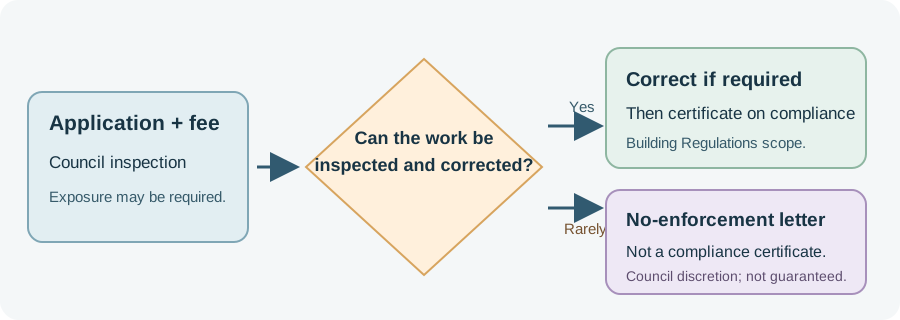
The Council’s regularisation guidance says its application route covers work carried out after November 11, 1985. The applicant submits a form and fee, then arranges an inspection. Depending on the work, the inspector may require part of it to be exposed. If the work complies, the Council says it will issue a regularisation certificate; if remedial work is needed, that work must be corrected before the certificate is issued. Ask the Council what standard applies to the work date and what access or professional input it requires.
The rare letter has a narrower meaning
The Council says that in rare cases it may issue a letter confirming that no further enforcement action will be taken where the work cannot be exposed, particularly where the work predates 1985. The page does not describe this letter as a certificate or as proof that the work complies with Building Regulations. It is not a guaranteed alternative if exposing the work is difficult or inconvenient.
Carmarthenshire’s page was updated July 2, 2026 and links to a new application form, but does not give a fee amount. Confirm the current form, fee, work-date eligibility, inspection requirements, and exact wording of any document with Building Control. This is one Council’s local guidance, not a Wales-wide rule. Keep planning and other approvals separate; for another devolved system, see the Northern Ireland regularisation guide.