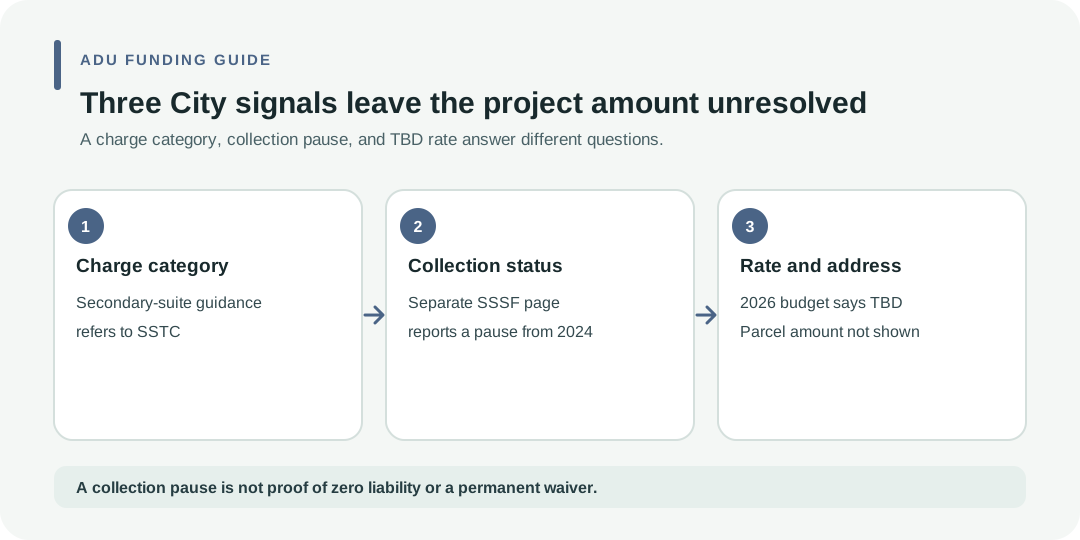
Edmonton’s public material contains three separate signals about the sanitary trunk charge associated with secondary suites: the City’s secondary-suite guidance refers to a charge, a separate sanitary funding page reports a collection pause, and the 2026 approved budget lists a rate as to be determined. Those statements do not establish what an applicant at a specific address will owe today.
Separate the charge category from collection
The secondary-suite page tells applicants to account for a sanitary trunk charge (SSTC). The City’s Sanitary Servicing Strategy Fund (SSSF) page separately says collection of the SSTC was paused effective May 13, 2024. A pause in collection is an administrative status; by itself it does not amend a charge, erase a prior amount, create a permanent exemption, or say how the pause applies to every permit period.
The 2026 approved budget lists the rate as TBD. That does not provide a current amount or a formula that can safely be applied to an address. The public information consulted for this guide does not reconcile the collection language with the budget rate or establish a later adopted schedule.
Request a current written assessment
Before including the charge as zero or as a specific dollar amount in a project budget, ask Edmonton’s administering authority to confirm in writing whether SSTC applies. Include the property address, suite type, application and permit dates, and project scope. Ask what rate or policy applies, when any charge is triggered, whether the pause changes collection or liability, and whether a later payment can arise.
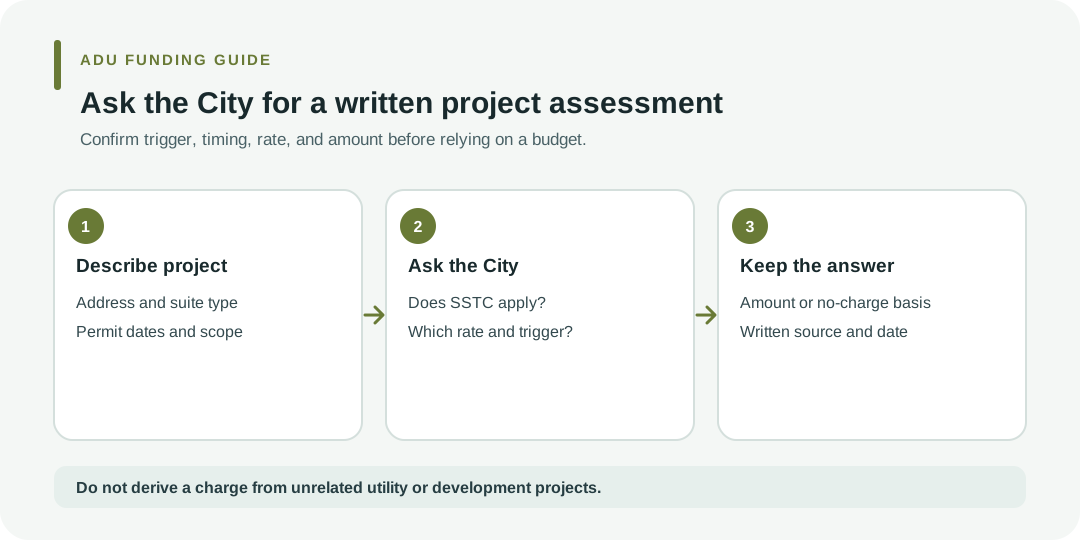
Keep the City’s reply with the permit and utility records. A general webpage, budget line, paused collection notice, or another development’s estimate does not decide a parcel-specific charge. Separately confirm wastewater connection requirements, capacity, permit approval, inspections, and occupancy; these are not answered by the SSTC status alone.
For how utility and development charges differ from ordinary permit fees, see Development, utility, connection, and capacity charges.
Key points
- The City’s secondary-suite material refers to SSTC, a separate City page reports collection paused from May 13, 2024, and the 2026 budget lists a TBD rate.
- The available public signals do not prove a current amount, a zero charge, or a permanent waiver.
- Request a dated written assessment for the address and permit period before relying on a budget figure.
- Charge status does not replace utility, permit, code, or occupancy review.