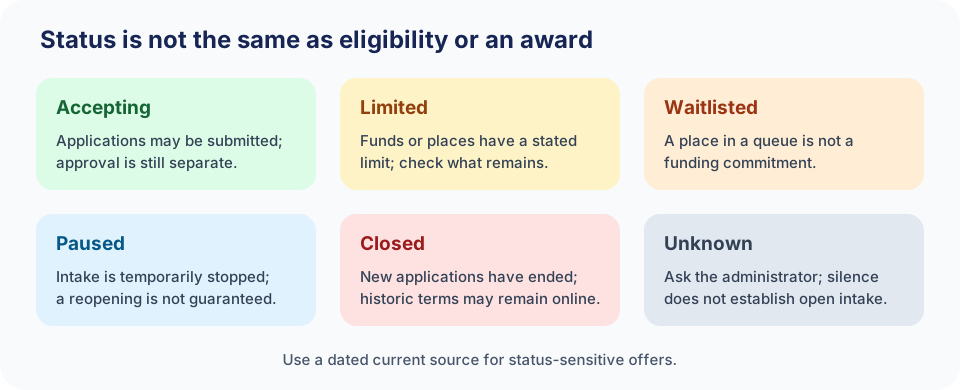
Public ADU assistance is a collection of separate programs, not a single benefit available everywhere. A program may be open, closed, waitlisted, limited to a certain kind of project, or described without publishing its remaining budget. Check the administrator’s current page and application terms before treating a benefit as available.
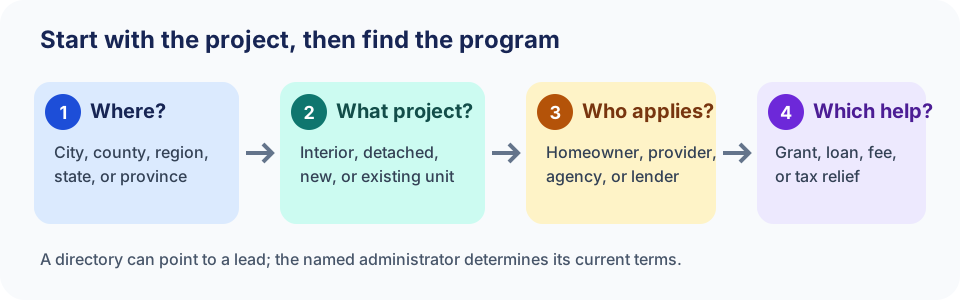
Start with the administrator and status
For each lead, identify the government or public agency that administers it, the places it covers, the eligible applicant and project, the covered costs, the application route, and the latest stated intake or budget status. A broad directory is useful for finding leads, but a listing is not proof of open intake or an award. California’s housing department, for example, lists potential state and local assistance and directs applicants to local administrators. CalHFA’s published ADU Grant page says its latest round was fully allocated on December 28, 2023; the historical maximum of $40,000 should not be read as an open grant.
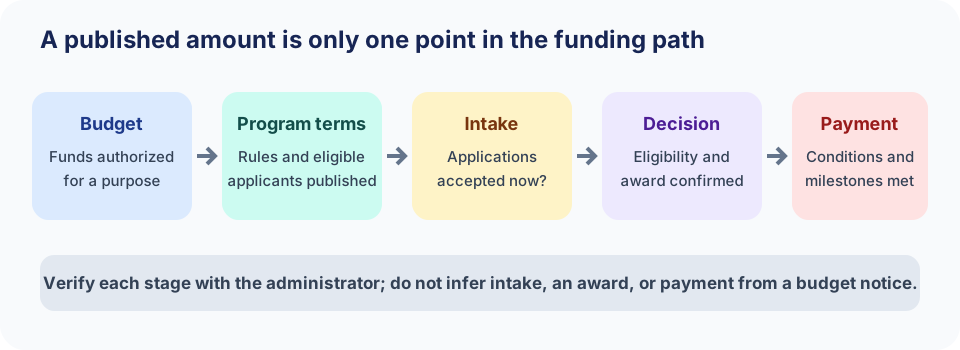
Examples of different assistance pathways
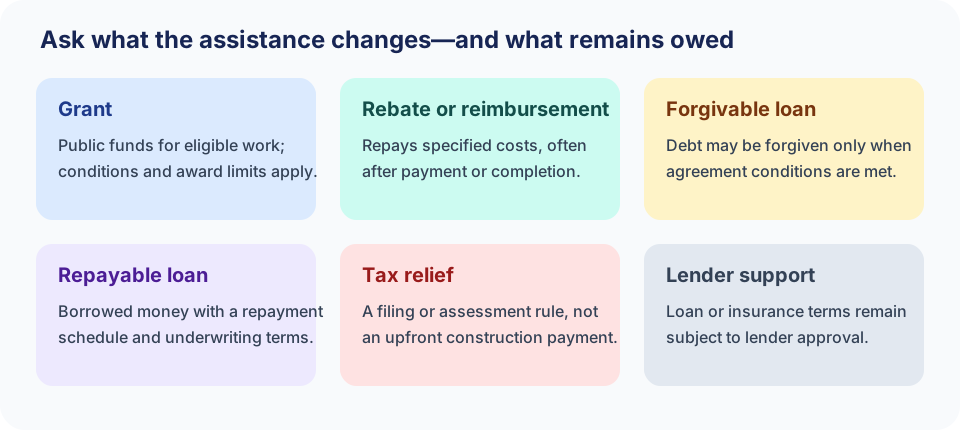
Saskatchewan’s Secondary Suite Incentive is a provincial grant for qualifying new suites at an owner’s primary residence. The program page states a grant of 35% of eligible construction costs up to C$35,000. Eligible costs must be incurred by March 31, 2027, and a completed suite and application are due by December 31, 2027. Saskatchewan’s 2026–27 budget identifies C$17 million for the program and a C$7 million increase attributed to uptake; those budget figures do not reveal the balance remaining or guarantee an award. The Saskatchewan grant guide explains the unit, completion, cost-evidence, and application conditions.
Canada’s Multigenerational Home Renovation Tax Credit is a separate federal tax credit, not a grant or loan. For one qualifying renovation, the Canada Revenue Agency allows a claim on up to C$50,000 of eligible costs at 14.5%, for a maximum credit of C$7,250. Age or disability, family relationship, ownership, occupancy, completion, receipts, and local-compliance requirements apply. See the eligibility and continuing-conditions guide; confirm tax treatment with the CRA or a qualified tax professional.
Other examples have different boundaries:
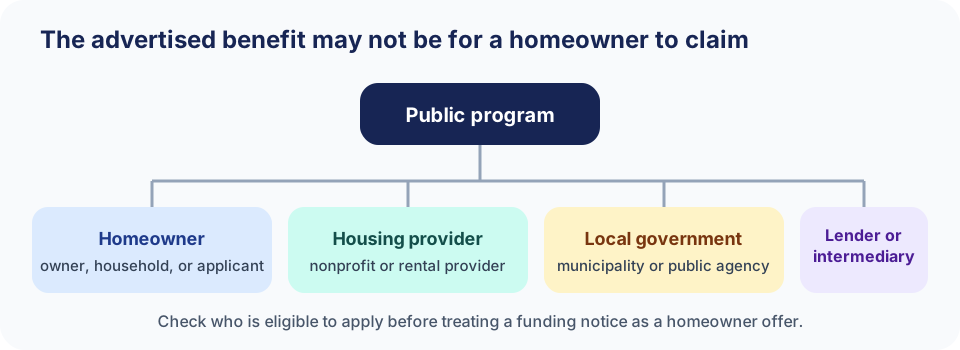
- The City of Orlando publishes a local ADU incentive combining a build-out rebate with specified impact-fee and building-permit-fee rebates. Read the Orlando program guide for location, rent, and site conditions; the page does not state remaining funds.
- Calgary’s interior-suite and separate Backyard Suite incentives both closed September 28, 2026. Before closure, the City placed applications made after June 23 on a waitlist; placement did not guarantee funding. Its program page, checked October 24, lists receipt verification for submissions dated September 27. That is a processing snapshot, not open intake or a payment date. See the Calgary program guide.
- Massachusetts has announced feasibility-study assistance and public design resources, alongside separate financing and budget measures. The state’s ADU hub described proposed regulation revisions and a public-comment period scheduled to end October 9, 2026. That date has passed; the proposal is not final regulation unless the Commonwealth publishes an adoption notice. The hub does not establish a homeowner grant or parcel approval.
- A March 2026 announcement describes Massachusetts second-mortgage financing of up to US$250,000 for a detached ADU and US$150,000 for an attached ADU. MassHousing’s current ADU Loan Program describes a combination of interest-bearing and zero-interest deferred-repayment financing. Applicants need plans, permits, and other predevelopment materials ready before contacting a participating lender. It is financing rather than a grant; confirm current terms, income eligibility, and individual approval with MassHousing or a participating lender. The Massachusetts ADU loan guide describes the preparation and lender steps. A separate state capital-budget entry is an allocation, not a homeowner award.
- Ontario’s Development Charge Reduction Program is a municipal mechanism: participating municipalities were required to reduce charges under program terms, and the latest evidence records application status as closed. Its Non-Development Charge Municipalities Stream is also for municipal infrastructure applicants; applications were scheduled to open October 29, 2026. Neither program creates a direct homeowner grant or a parcel-level charge exemption.
- New York City’s Plus One ADU page reported intake closed on June 12, 2026, despite a March reopening announcement. British Columbia’s provincial pilot stopped accepting applications after March 30, 2025; committed applications continued to be processed. Neither past announcements nor historic loan amounts establish current intake.
- Canada’s proposed Secondary Suite Loan Program was stated in Budget 2025 not to be implemented. Do not reuse earlier proposed loan amounts as current availability. CMHC’s separate refinance product is a lender-insurance pathway, not that proposed program.
Pasadena announced a separate Second Unit ADU construction-financing round in January 2026: up to US$225,000 at 1% simple interest, with no payments for three years during construction and lease-up, a planned limit of 25 ADUs, and seven-year rental to a Pasadena Housing Choice Voucher holder. The release said applications were being accepted at that time, but it does not establish current intake, remaining funds, complete underwriting, or individual approval. Ask the City for the current handbook before counting the financing. The announcement is a status lead, not a current offer confirmation.
Local programs with current deadlines or limited intake
The examples below are local offers, not general entitlements. The maximum does not prove that an application is being accepted, funds remain, or a specific address qualifies.
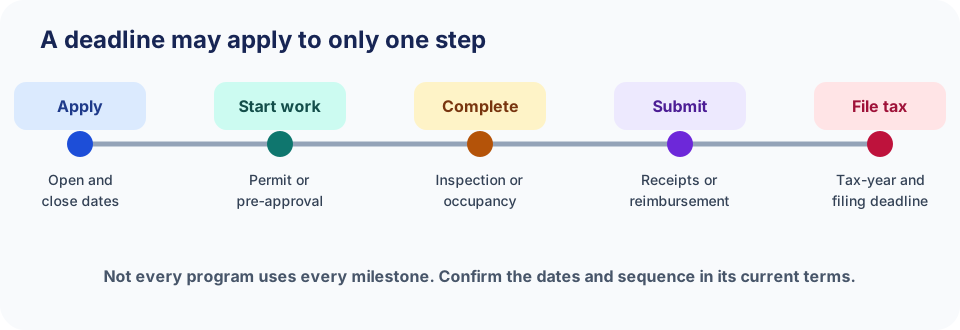
Application dates, work-start rules, completion milestones, receipt deadlines, and tax filing dates answer different questions. Check which dates apply to the specific program before planning work or relying on a benefit.
| Location and guide | Published assistance | Status or limit to check |
|---|---|---|
| Saint John ADU Grant | C$15,000 for a secondary suite or C$25,000 for a garden suite under the 2026 amended policy | The policy specifies the Primary Development Area, municipal water and sewer, a permitted main dwelling, and final-inspection conditions. Remaining capacity is not stated. |
| Comox Home Suite Home | C$3,000 for a qualifying new or upgraded unit | Limited to the first 25 units and a C$75,000 total; the Town page states an end date of December 1, 2027 or earlier exhaustion. |
| Kingston ARU incentives | Five grant or forgivable-loan streams, including base maxima of C$40,000 for detached or C$30,000 for interior units | New applications are waitlisted. A building permit must issue by December 1, 2026 for consideration; waitlist placement is not a funding promise. |
| Collingwood Rapid ARU Grants | C$10,000 after required approvals, plus C$5,000 for a separate County of Simcoe loan participant | The Town page says 2026 applications are open and lists C$100,000 in funding. Ask Collingwood about the remaining balance. |
| Hamilton ADU and Multi-Plex Incentive | Up to C$40,000 per eligible unit and C$240,000 per site | Available only inside the mapped Housing for Hamilton area and subject to City approval and available funds. |
| Whitby ADU fee reimbursement | One-time reimbursement for selected fees already paid | A complete permit application is due by December 31, 2026; agreement and registration deadlines follow in 2027. |
| Truckee forgivable loan | Up to US$50,000 under one of two rental-affordability options | The guidelines state the program runs through December 31, 2026 or earlier if funds run out. The Town page’s July 1 availability statement does not show today’s balance. |
| Napa County Affordable ADU Loan | County materials describe loans from US$60,000 to US$105,000, forgiven over five years when terms are met | The current County page provides an interest-form route; current balance, location, rent limits, and approval need County confirmation. |
| Ulster County Plus One | Up to US$112,500 for qualifying construction or rehabilitation | The County summary does not state current intake or remaining funds. |
| Boston ADU Financial Assistance | Up to US$7,500 for design/permitting soft costs and a separate US$50,000 deferred, zero-interest City loan | The current City page links to an application, but awards, income qualification, and any partner-bank financing remain subject to review. |
| Queen City ADU Program | The published packet describes up to US$80,000 in forgivable financing | Charlotte says applications closed October 31, 2025. Its current interest form gathers contacts for future updates; it is not an application. |
| Guelph ADU Grant | The former grant had homeowner and project streams | Guelph says all ADU grant funding is allocated and new applications are closed while eligible applications already received are processed. |
The City pages for Concord, Dublin’s regional ADU Accelerator, Fairfield, East Hampton, and Chula Vista also show that older offers may expire or pause. The cited records report Concord’s September 30, 2026 rebate deadline and Dublin’s September 30, 2026 accelerator end date as elapsed; Fairfield’s applications paused pending funding; East Hampton’s 2026 pilot application period closed; and Chula Vista’s loan pilot closed in June 2024. Those pages do not confirm how pending files were handled or whether a successor round has opened. Check each administrator before treating historic terms as current funding.
Tax relief and annual filing
Washington law includes a three-assessment-year improvement exemption for some single-family improvements, including ADUs, and separately allows local low-income ADU rental exemptions in qualifying counties that opt in. The notice, value, tenant, rent, lease, and local implementation tests differ; see the Washington property-tax guide and confirm the parcel with its assessor. Salem, Massachusetts, has an annual property-tax exemption for qualifying affordable ADUs. Its posted filing period ends September 1; the 2026 filing date has passed, so check the next cycle and current Fair Market Rent with the Assessing Department. The Salem guide explains the calculation and required records.
A public budget, historic maximum, closed waitlist, or past announcement is not an individual award. Confirm the administrator’s current intake and balance before changing a project or financing plan around a listed benefit.
A practical status check
Before spending money or changing a project around an advertised benefit:
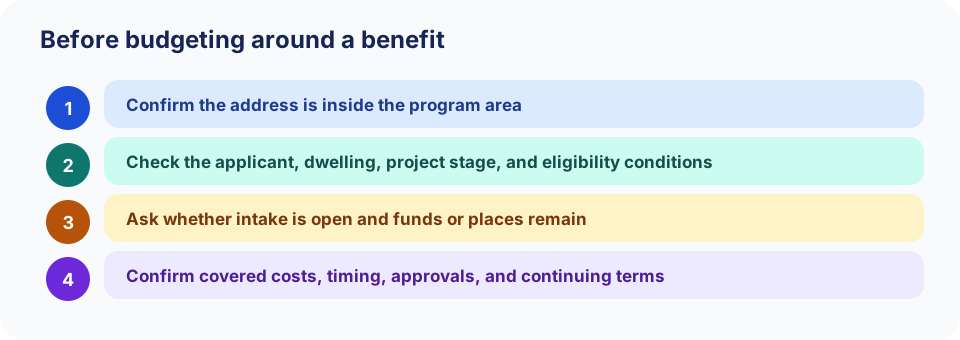
- Confirm the administering authority and that the address lies inside its program area.
- Read the current application guide, not only an announcement or directory entry.
- Check intake dates, waitlists, remaining funds, eligible costs, approvals, and payment timing with the administrator.
- Check whether permits, inspections, registration, affordable rent, occupancy, or a recorded restriction must be satisfied.
- Keep the benefit separate from zoning permission, building approval, utility capacity, ordinary permit fees, and private financing.
Program pages and budget allocations change. Where an administrator does not publish current capacity or decide individual eligibility, treat that answer as unresolved and ask the administrator directly.