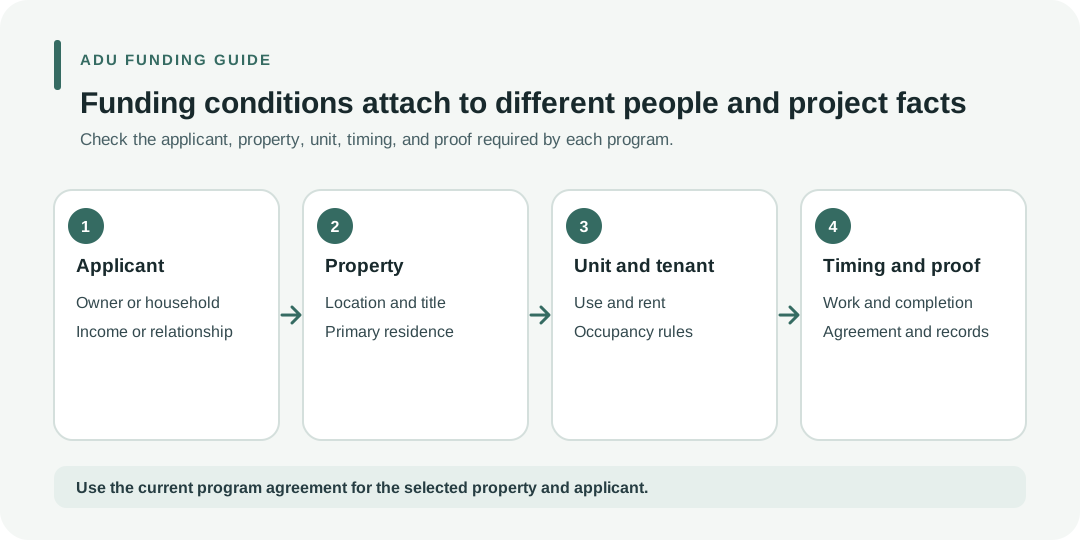
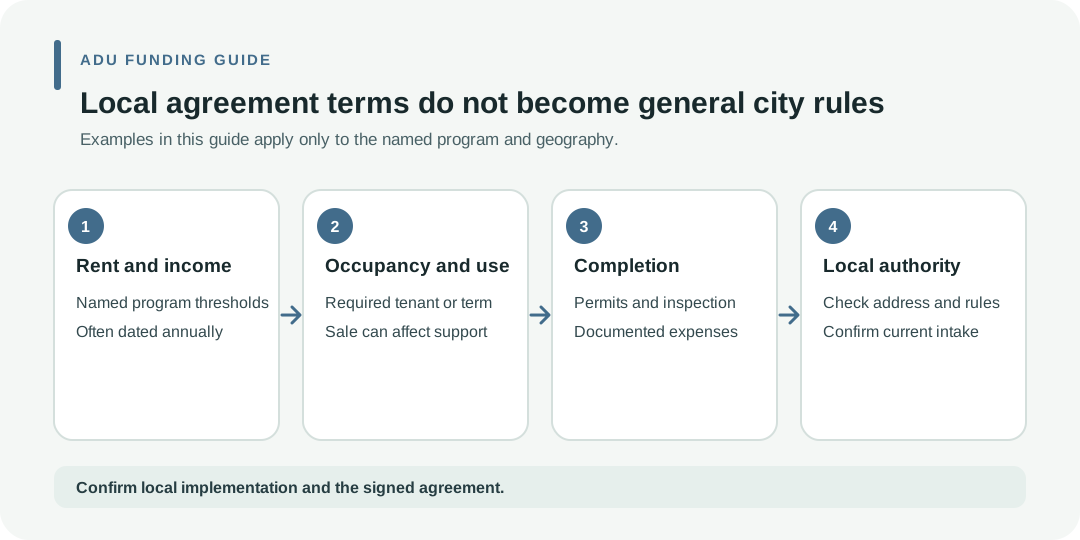
An assistance program can attach obligations to the applicant, the property, the unit, its occupants, or the project’s completion. Those terms apply to the specific program; they do not automatically become general rental or zoning rules for the surrounding city.
Compare the condition with the benefit
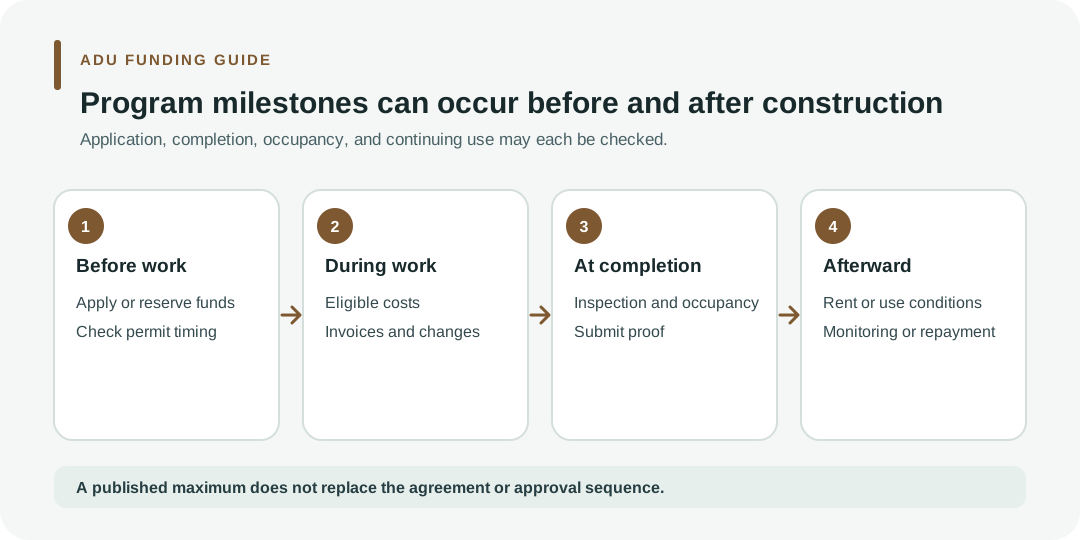
Read the agreement or current program guide alongside the advertised amount. Check who must own or occupy the property, which household or income thresholds apply, when the unit must be completed, what proof is required, how long a restriction lasts, and whether the benefit can be reclaimed after a sale or change in use.
Orlando’s published incentive requires the ADU to be rented to a resident with income at or below 120% of area median income for 12 of the first 24 months after the certificate of occupancy. The page says the lease requirement may be waived for a resident age 62 or older. This is a condition of the Orlando incentive, not a citywide rent rule. See the Orlando program guide for its separate site checklist and rebate terms.
Calgary’s incentive applied to suites within the main dwelling, required an active building permit, and tied reimbursement to eligible safety work, inspections, suite registration, and paid receipts. Funded suites cannot receive a short-term-rental business licence for two years after funding unless the funds are returned in full. These are program terms, not a general rental rule for Calgary. The City closed the Secondary Suite and Backyard Suite incentive programs to new applications on September 28, 2026. The Secondary Suite Incentive Program page says applications made after June 23 were placed on a waitlist and that no new applications are accepted. When checked on October 24, receipt verification was working on submissions dated September 27; that processing snapshot does not show open intake or promise a payment date.
Completion, occupancy, and records
Saskatchewan’s grant is limited to qualifying new secondary suites at an owner’s primary residence. Its program page sets cost-incurrence and application deadlines, requires the new suite to be complete, and requires an occupancy certificate or equivalent before applying. A builder contract or deposit alone does not show that a cost was incurred by the deadline. See the Saskatchewan grant guide for the qualifying unit features and the program’s application evidence.
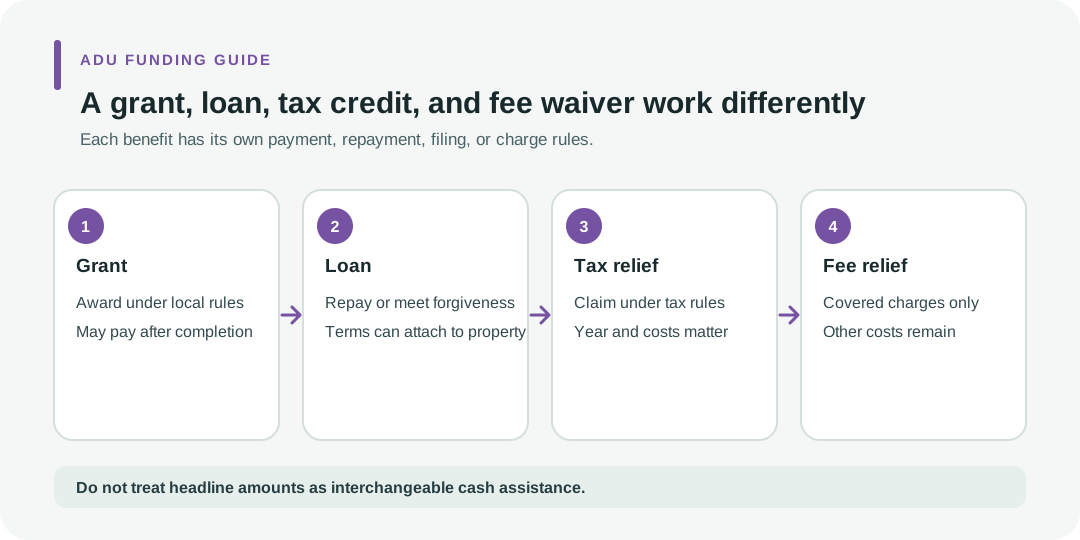
Canada’s Multigenerational Home Renovation Tax Credit has a separate eligibility test. It applies to a qualifying renovation that creates a self-contained unit, with occupancy, relationship, local-compliance, completion-year, and expense rules. CRA’s current tax-year-2025 page lists 14.5% on up to C$50,000 of eligible costs, for a maximum C$7,250; do not carry that rate into another tax year without checking. See the MHRTC guide for the qualifying-person and unit tests. Personal claim eligibility and expense treatment still require CRA or tax-professional confirmation.
Charges and restrictions can use different tests
England’s Community Infrastructure Levy guidance describes a possible residential-annex exemption for an annex within the grounds of the owner’s home. The claim and commencement notice must be handled before work begins. Within three years of completion, the exemption can be withdrawn if the main house is used for a purpose other than as a single dwelling, the annex is let, or either the main residence or annex is sold separately from the other. The guidance defines completion by the issue of the annex’s compliance certificate. Check the collecting authority’s process and current rules; this is England-specific guidance, not a UK-wide rule.
Somerset Council publishes a local residential-annexe relief process. Its page names the ownership, main-residence, ancillary-use, and pre-commencement conditions; the Somerset guide explains the local steps and a timing point that needs authority confirmation.
Marin County’s published fee-waiver examples are limited to unincorporated Marin County. Its additional affordability-based waivers require a deed restriction, at least five years of affordable use, and annual tenant-income and lease documentation. A reader in an incorporated city should not assume the County program applies.
Local programs with continuing conditions
Truckee ties forgiveness to both occupancy and the selected tenant standard. Its seven-year option requires year-round rental to a locally employed tenant at or below 60% of area median income; the ten-year option uses a 120% AMI ceiling. Each has a 12-month minimum lease, and a sale before the term matures can make the remaining loan balance due. Confirm which option the administrator offers and the local-employment test before relying on the loan. See the Truckee guide.
Napa County’s Affordable ADU loan requires the applicant to own the property and use it as their primary address at application. Tenants, including relatives, must meet the program’s income limit. The County page lists monthly maximum rents of US$3,171 for a one-bedroom unit and US$3,524 for a two-bedroom unit as of June 2026, and says rents and income limits update annually. The ADU must be completed within 24 months of approval by a licensed contractor; expenses before a reservation of funds are not covered. Check the Napa County loan guide for the date and locality limits on those values.
Ulster County’s Plus One summary sets a household ceiling of 100% of County AMI and an affordable-rent term of at least ten years. It describes grants up to US$112,500 for construction or rehabilitation of a code-compliant attached or detached ADU. The summary does not publish the detailed rent schedule, current intake, or remaining funds. See the Ulster County guide and confirm the agreement with its program administrator.
Boston’s assistance is for owner-occupants of one- to three-unit Boston homes. The current City page lists income and asset requirements, being current on housing-related payments, attendance at both ADU Design and Budget Workshops within the previous three months, and work with a licensed architect. The City loan is deferred and 0% interest; it is due on a sale, transfer, or cash-out refinance. The separate design/permitting grant is reimbursed after permit approval and City loan enrollment. See the Boston guide for the application sequence.
Collingwood’s C$10,000 Town grant requires a new ARU, planning permissions, and year-round rental for five years with annual proof of a 12-month lease. The additional C$5,000 Town grant is available only after approval for the County of Simcoe Second Suites program, which carries a separate 15-year affordability commitment. The Collingwood guide keeps the Town grant and County loan conditions separate. Kingston has its own five-year term for base forgivable loans; an accessibility grant has no ongoing term, and the City’s current waitlist does not guarantee funding. See the Kingston guide.
Comox requires a signed declaration to keep a qualifying ADU in residential use for at least five years and an occupancy permit within 14 months after building-permit issuance. The program page states that funding is limited to the first 25 qualifying units and may end earlier than December 1, 2027 if funds run out. Hamilton’s grant is tied to eligible post-permit costs, a grant agreement, and occupancy and inspection milestones; missed deadlines or other defaults can require repayment. See the Comox and Hamilton guides.
Charlotte’s Queen City ADU packet describes rent at or below 80% AMI, a rent ceiling tied to 70% AMI studio Fair Market Rent, annual documents, and forgiveness over up to eight years. The current Charlotte page says applications closed on October 31, 2025. The packet explains historic terms; it does not create a current offer. Salem, Massachusetts, has an annual tax exemption instead of a construction award: rent including utilities may not exceed 70% of current HUD Fair Market Rent, and the City requires an occupancy certificate, lease or qualifying tenant attestation, inspection, and annual application. The posted 2026 filing date has passed. See the Charlotte and Salem guides.
Washington’s local-option property-tax exemption has its own tests: qualifying jurisdictions must opt in, the tenant household must meet the income threshold, rent must be within the statutory limit, and the lease and annual application must meet the law. This path is separate from the broader improvement exemption for certain single-family improvements. See the Washington guide and ask the county assessor about local implementation.
Mill Valley: an existing-use conversion incentive
Mill Valley’s Lease to Locals extension, announced August 18, 2026, runs through June 2027. The City describes a one-time incentive of up to US$14,000 when a home, ADU, or room is converted to a long-term rental for the local workforce or disabled community. The lease must run for at least 12 months, and the amount depends on the number of qualified tenants. The program is limited by available funds; the announcement does not state the current balance.
This is an incentive to place existing residential space into qualifying long-term rental use. It is not a construction grant, permit, or promise that an ADU can be created on a particular property.
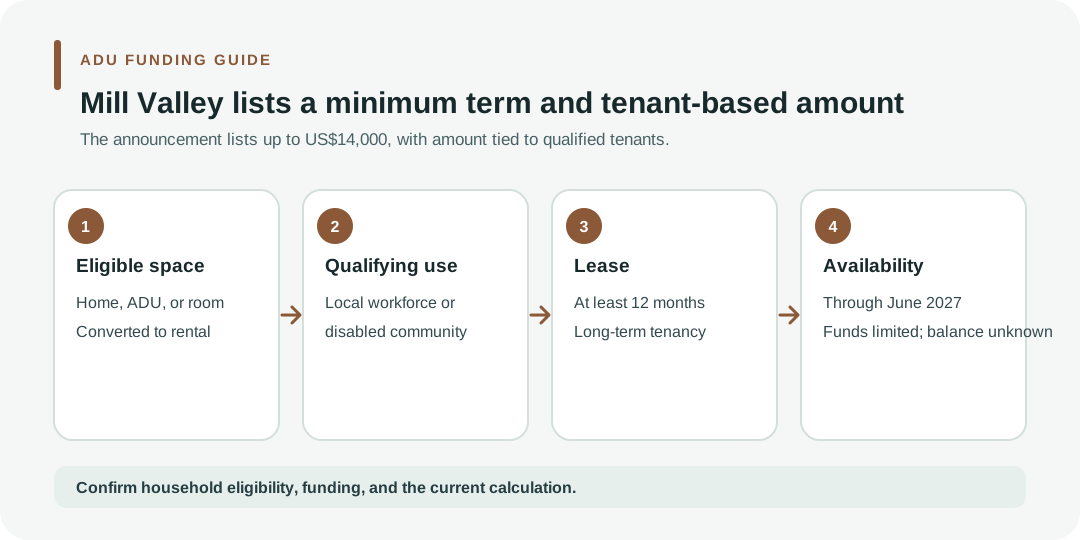 Ask the City or its program administrator, Placemate, about current funds, household qualification, lease documentation, and how the one-time amount is calculated.
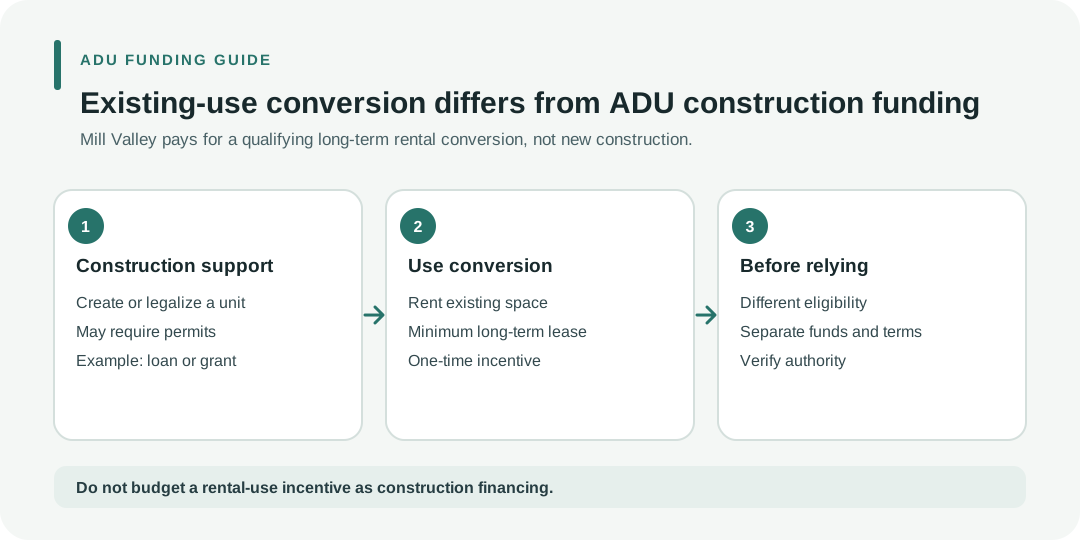
Verify before committing
Confirm the terms with the program administrator, including who must sign, which documents prove eligibility, when applications are accepted, what happens after a sale or occupancy change, and whether conditions attach to the title. Separately confirm planning, building, utility, and occupancy requirements with the relevant authorities. A funding condition or tax credit does not legalize a unit or establish that its design is approvable.