The Multigenerational Home Renovation Tax Credit (MHRTC) is a federal refundable tax credit for qualifying renovations that create a self-contained secondary unit for a qualifying person and relation. It is claimed through a tax return after the renovation. It is not an upfront ADU grant, and a project must satisfy Canada Revenue Agency (CRA) rules as well as local planning and building requirements.
Check the people and the new unit
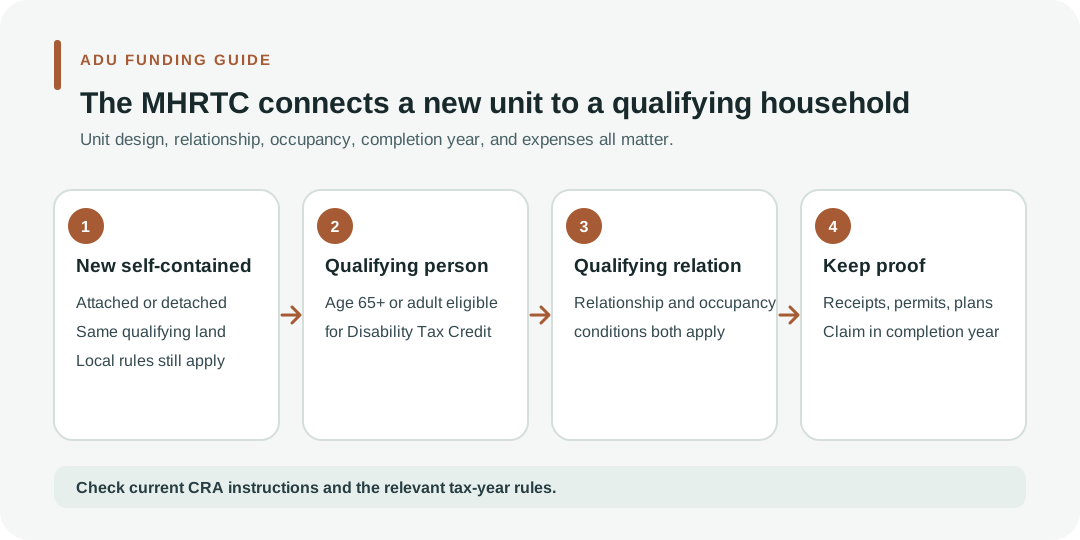
CRA requires the renovation to create a self-contained secondary unit with a private entrance, kitchen, bathroom, and sleeping area. The unit can be attached to the qualifying dwelling or located in a separate structure on the same land. It must meet applicable local requirements. Buying a home with a pre-existing suite does not by itself meet the renovation test.
A qualifying individual must be a senior aged 65 or older by the end of the tax year, or an adult eligible for the Disability Tax Credit. The qualifying individual and an eligible relation must ordinarily live, or reasonably expect to live, in the dwelling within 12 months after the renovation period. CRA also limits the credit to one qualifying renovation per qualifying individual in that person’s lifetime. Relationship, ownership, and other conditions apply; check CRA’s current guide for the exact test.
Match expenses and the tax year
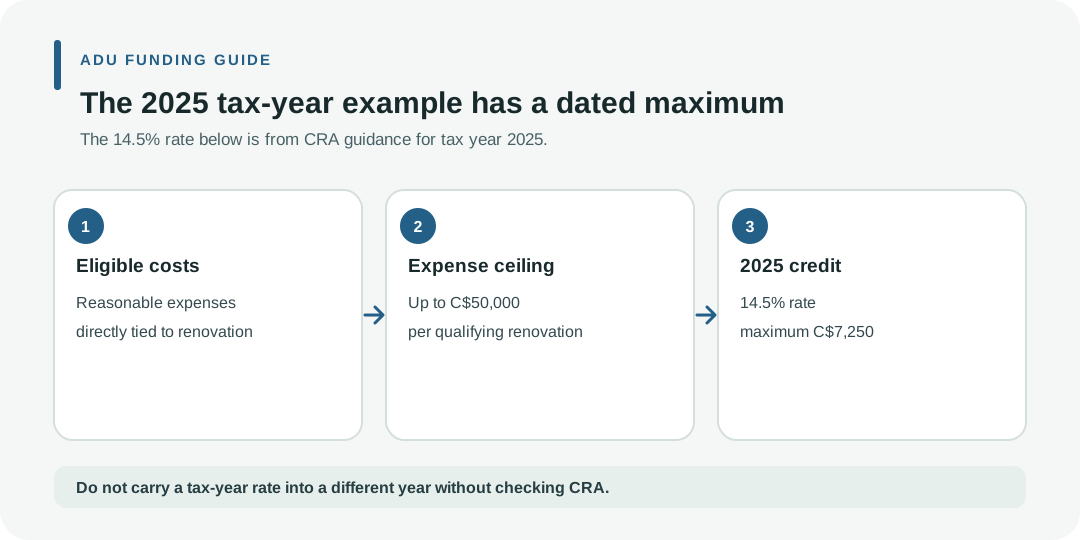
The renovation must be completed in the tax year claimed. CRA requires supporting documents such as receipts, and eligible costs must be reasonable and directly attributable to the qualifying renovation. The general expense cap is C$50,000 for one qualifying renovation, shared across eligible claimants.
On CRA’s current page for tax year 2025, the refundable credit is 14.5% of eligible expenses, up to C$7,250. This is a dated example, not a rate to apply automatically to later returns. Confirm the rate, expense categories, claim line, supporting records, and completion year in CRA instructions for the tax year being filed.
Other tax relief has separate tests
The Home Accessibility Tax Credit is a different, non-refundable credit for qualifying accessibility or safety expenses and qualifying people; CRA does not say ordinary ADU construction automatically qualifies. The New Residential Rental Property rebate has its own property, rental, construction, and filing rules. The purpose-built rental housing rebate is for qualifying larger rental complexes and has a four-apartment or ten-private-room threshold and requires at least 90% of residential units to be held for long-term rental; one standalone secondary suite does not meet that threshold by itself.
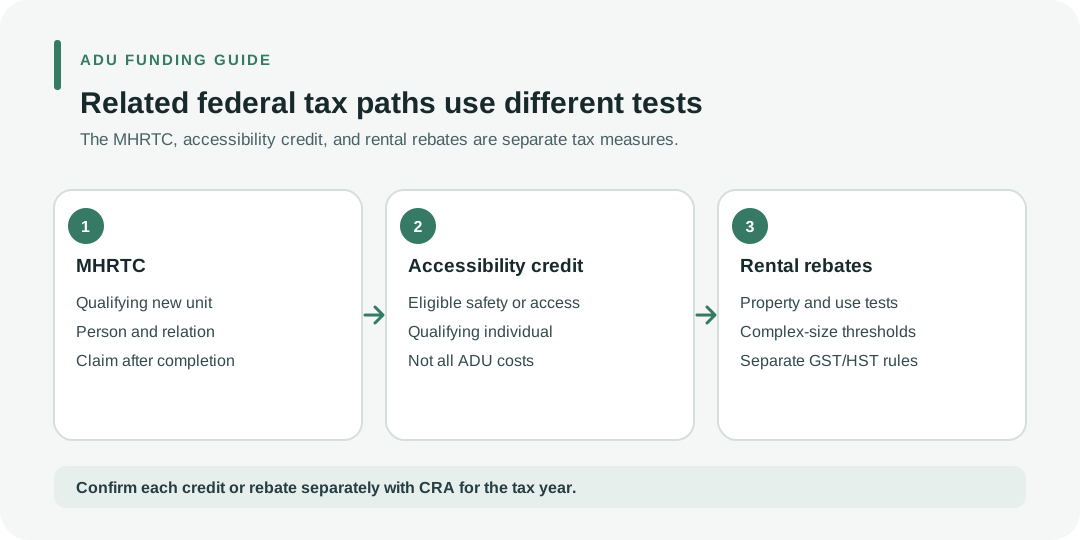
Do not combine these tax paths as if they were one ADU award. A particular expense, building classification, mixed rental use, or taxpayer’s claim needs CRA or tax-professional confirmation. Separately verify local permits, code compliance, occupancy, and rental approval.
For conditions attached to grants, loans, and tax treatment, see Conditions Attached to ADU Funding. The CMHC refinance guide describes a separate mortgage-insurance route.
Key points
- The MHRTC is a refundable tax credit claimed after a qualifying renovation, not upfront construction funding.
- The unit, qualifying individual, relation, occupancy, completion year, and expense records all matter.
- CRA’s 2025 example lists 14.5% and up to C$7,250; check the rules for the tax year being claimed.
- Other federal tax credits and rebates use separate requirements; ADU eligibility is not automatic.