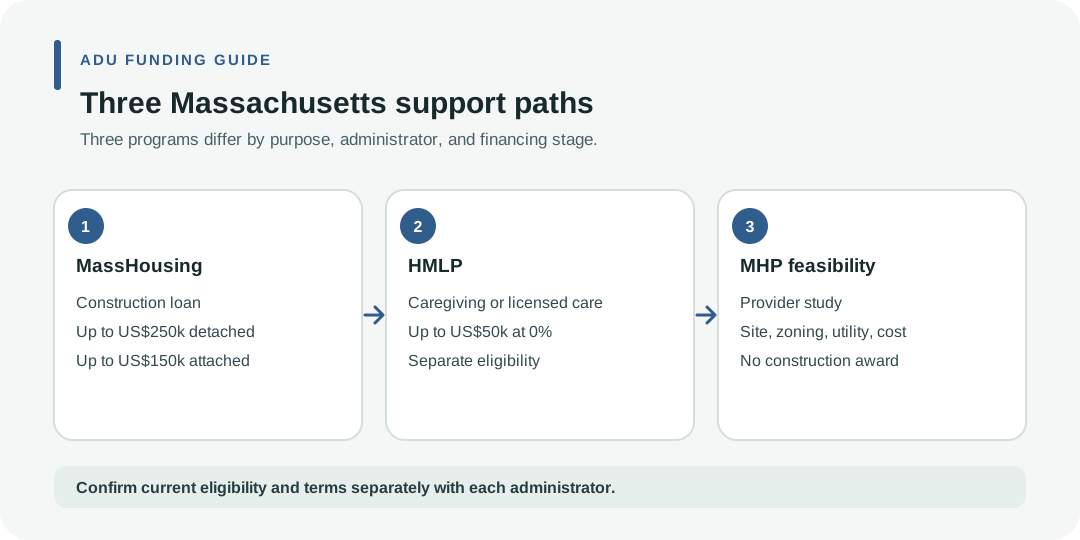
MassHousing’s ADU Loan Program offers construction financing to eligible Massachusetts homeowners. The current program page lists loans up to US$250,000 for a detached ADU and US$150,000 for an attached ADU. These are published maximums, not promised loan amounts or a grant; a participating lender must assess the borrower and project under the current program terms.
Understand the financing and property boundary
The program describes a combination of an amortizing, interest-bearing loan and a zero-interest, deferred-repayment loan. It is intended for construction of an ADU at a single-family home occupied by the owner as their primary residence. Household income limits vary by location, and the applicable terms and available amount depend on the project and the lender’s decision.
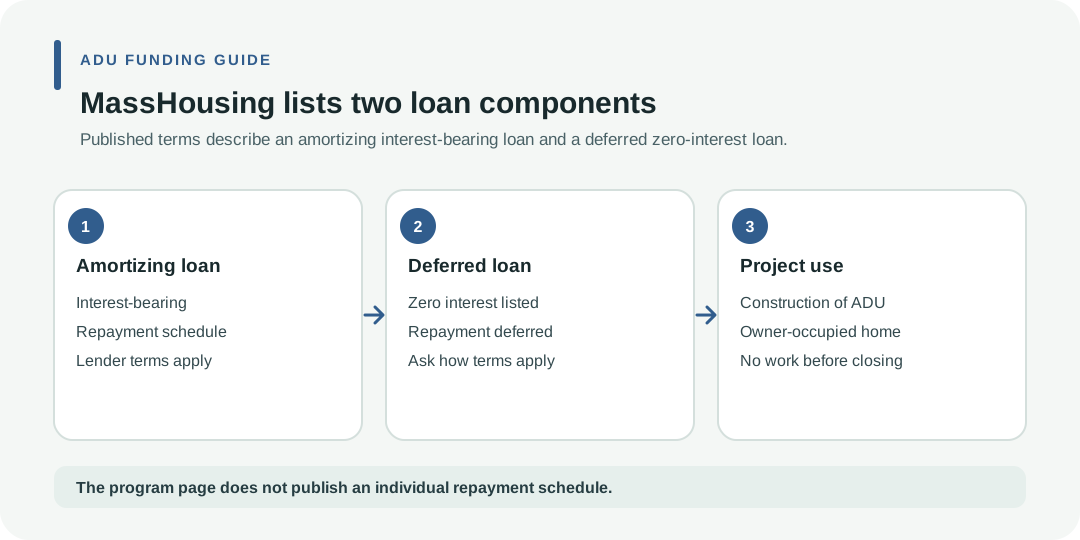
MassHousing identifies the product as construction-only financing. Its current materials require important predevelopment work, including plans and permits, before a homeowner proceeds to a participating lender. The project must not start before loan closing. Do not begin construction based only on a preliminary eligibility discussion or the published maximum.
Separate Massachusetts support routes
The MassHousing construction loan is one of several Massachusetts ADU pathways. The Home Modification Loan Program (HMLP) is a separate no-interest, deferred-payment loan. A 2026 Department of Developmental Services fact sheet lists HMLP support up to US$50,000 at 0% interest for an ADU intended for a multigenerational caregiving arrangement or a licensed professional providing 24-hour care. HMLP has its own disability/age, documented-need, and income rules; confirm current application and terms with MassAbility or the program administrator. The fact sheet says a homeowner may qualify for both MassHousing and HMLP, subject to each program’s tests, but that does not guarantee approval or a combined award.
Massachusetts Housing Partnership’s Phase One feasibility pathway is different again. The state announcement describes provider-based studies of site conditions, zoning and permitting, utilities, preliminary design, and high-level cost feasibility. This is early project assessment, not a homeowner construction grant or loan, and the announcement does not establish current provider availability or whether study costs are covered.
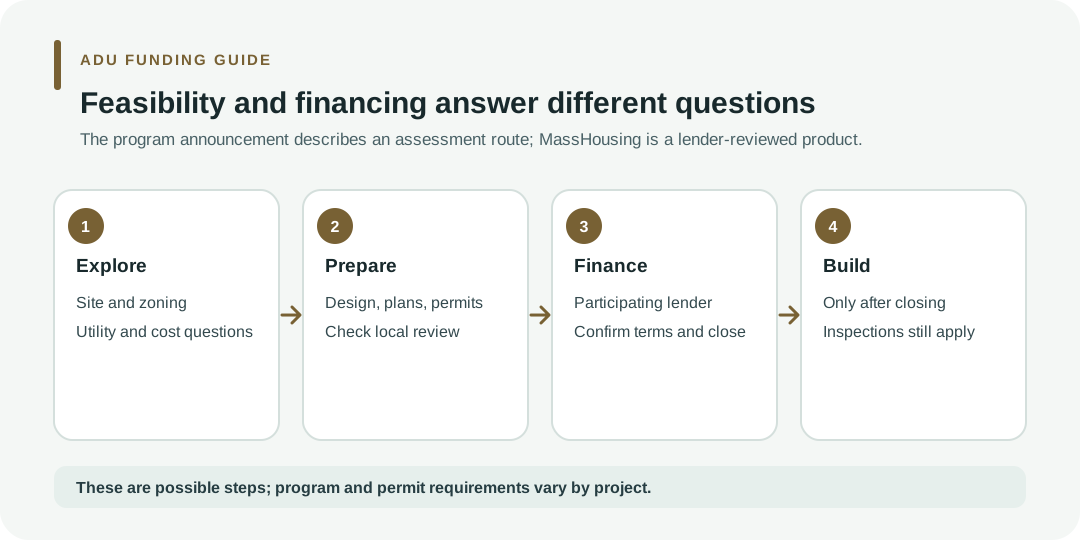
For an overview of those stages, from feasibility questions to loan closing and construction, use the current administrator documents; the steps below are not a required sequence for every applicant.
Find a participating lender and prepare
Use MassHousing’s current participating-lender directory to find a lender serving the property’s county. Before applying, gather the plans, permit documents, project budget, and other predevelopment materials listed by the program. Ask the lender to confirm the location-specific income limit, required documents, available loan structure, timing, and how the deferred-repayment portion works for the proposed project.
An announcement of the program or a published limit does not establish that a lender is currently originating a loan in a particular area or that an individual applicant will qualify. Confirm availability and all terms with MassHousing or a participating lender before relying on the financing in a construction budget.
Keep lending separate from project approval
The financing route does not replace local zoning, building-permit, code, fire-safety, utility, or occupancy approvals. A lender may require those documents as part of underwriting, but the local authority makes its own project determinations. The state ADU resource page also covers broader ADU rules and resources; proposed policy material on that page should not be treated as a lender commitment or parcel approval.
For a cross-location comparison of public assistance and program status, see the ADU grants, loans, rebates, and programs guide. For the conditions that can attach to specific assistance, see the funding-conditions guide.