Kitchener’s Missing Middle and Affordable Housing Community Improvement Plan (CIP) offers a grant toward specified development charges for eligible accessory dwelling units. The grant can reduce costs for a qualifying project, but it is not a blanket exemption from Ontario development charges or proof that a particular property owes a specific amount.
Check the unit-count tier
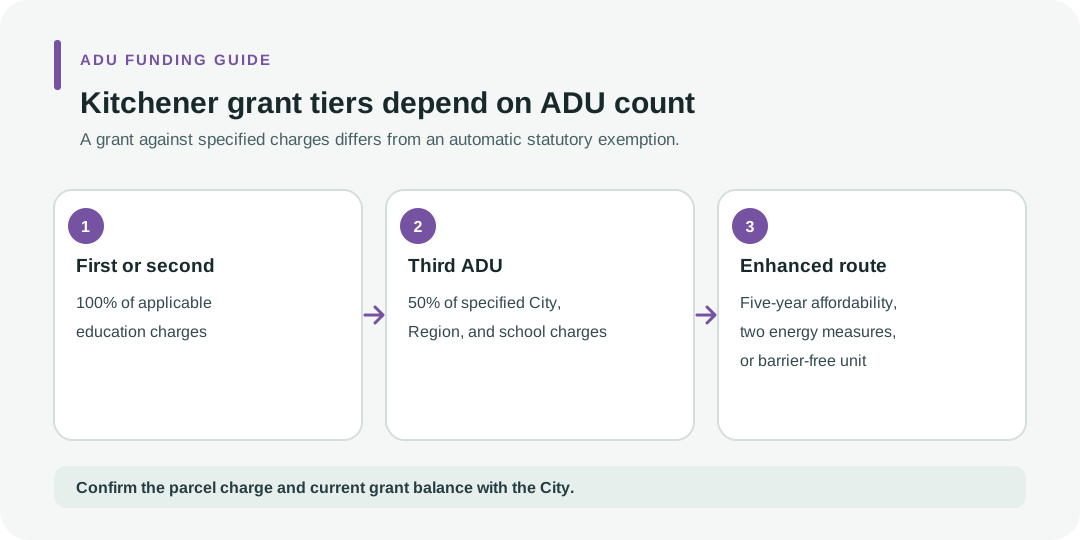
The City describes full support for applicable education development charges for a first or second ADU on an eligible property. For a third ADU, the published base grant covers 50% of applicable City, Region, and education development charges. The City lists enhanced paths that can raise support to 100% when a project meets one of these alternatives: five years of affordable rental use, at least two eligible energy-efficiency measures, or a barrier-free unit.
Eligibility depends on the property and its existing dwelling configuration. The grant is not the same as Ontario’s statutory development-charge exemption for certain additional units. The City administers the grant under its CIP, while the relevant charge authorities determine the charges and underlying calculations.
Check the permit date and application timing
The current City criteria require qualifying building-permit applications on or after January 5, 2026. The grant application window opened January 19, 2026 and is first-come while program funds remain. The City’s October 31, 2026 permit date is a prioritization target, not a published program closing date. Ask the City whether the application window and funding remain open before counting on support.
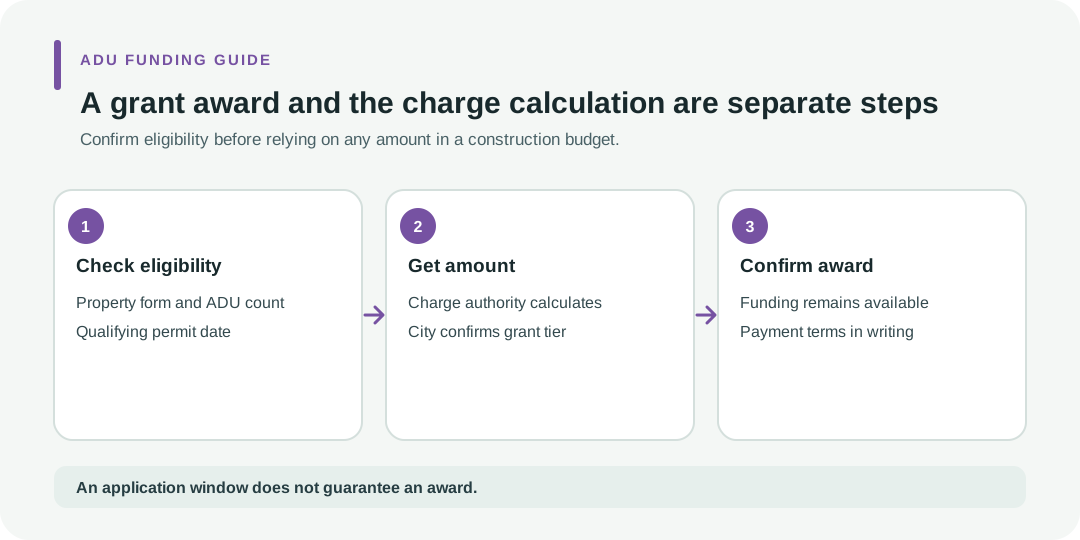
A grant application and a charge calculation are separate steps. Confirm property type, ADU count, applicable charge authority, eligible percentage, amount, and payment timing with the City and other charge authorities. Do not subtract a percentage from a budget before receiving a project-specific calculation and confirming an award.
Keep the program local
The Kitchener grant is for qualifying properties in Kitchener. Nearby municipalities have their own programs; for example, Waterloo City’s ARU grant and the Region’s Ontario Renovates loan have different administrators and conditions. See the Waterloo funding comparison before treating a nearby program as relevant.
Key points
- First and second ADUs: the City lists 100% of applicable education charges.
- Third ADUs: the base grant lists 50% of specified City, Region, and education charges; enhanced tests may allow 100%.
- A grant is not an automatic statutory exemption, and the actual charge amount is property-specific.
- The application window is first-come while funds last; the permit-priority date is not an expiry date.