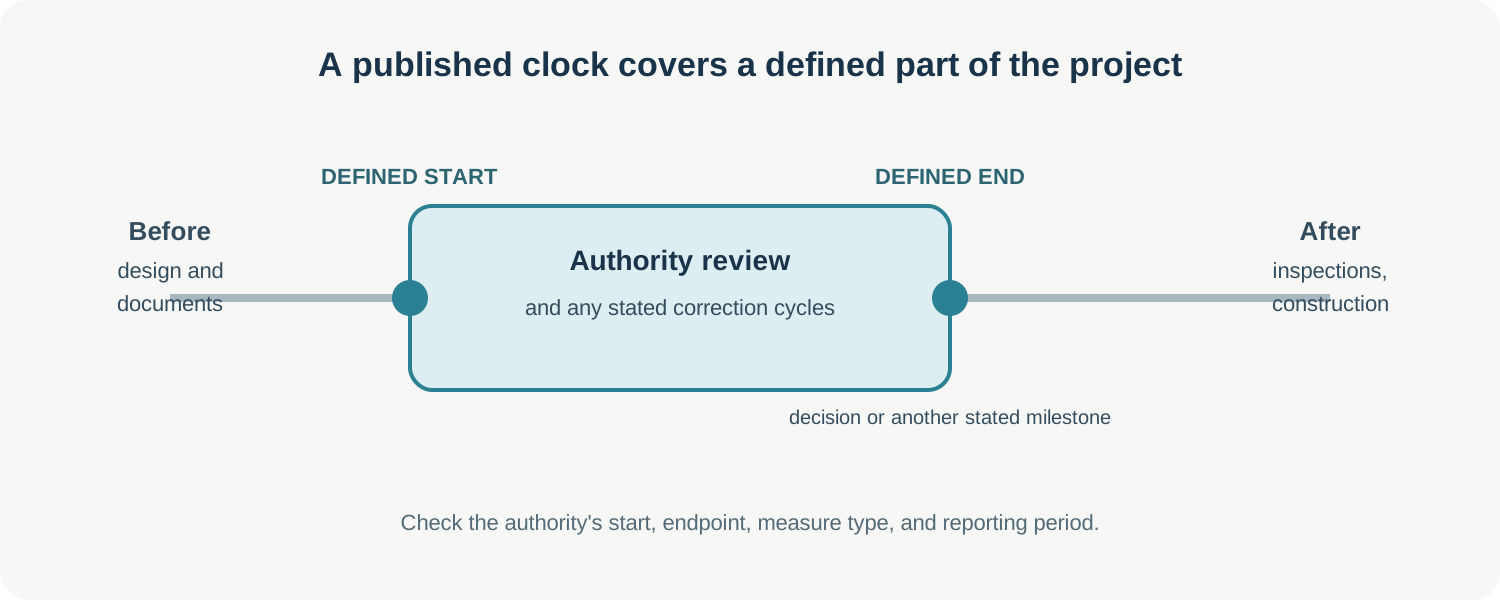
There is no reliable universal answer to “How long does an ADU permit take?” The clock may start at application, at a complete submission, or at another defined milestone. Planning, building, trade permits, inspections, and final certificates may each have a different process and decision-maker.
Find the clock that matches your application
Before using a published number, confirm:
- Authority and application class: Is the measure for this property, unit type, and permit stream?
- Clock start: Does time begin at submission, completeness, payment, or a later review milestone?
- Measure type: Is it a statutory decision period, a service target, a recent average, or a performance goal?
- Clock end: Does it end at an initial review, a decision, permit issuance, inspection, or completion certificate?
- Reporting period: When was the measure published, and when is it updated?
For dated examples from several authorities, see the comparison of official permit timeline measures. It keeps each authority’s clock, endpoint, and measure type visible instead of treating published numbers as interchangeable.
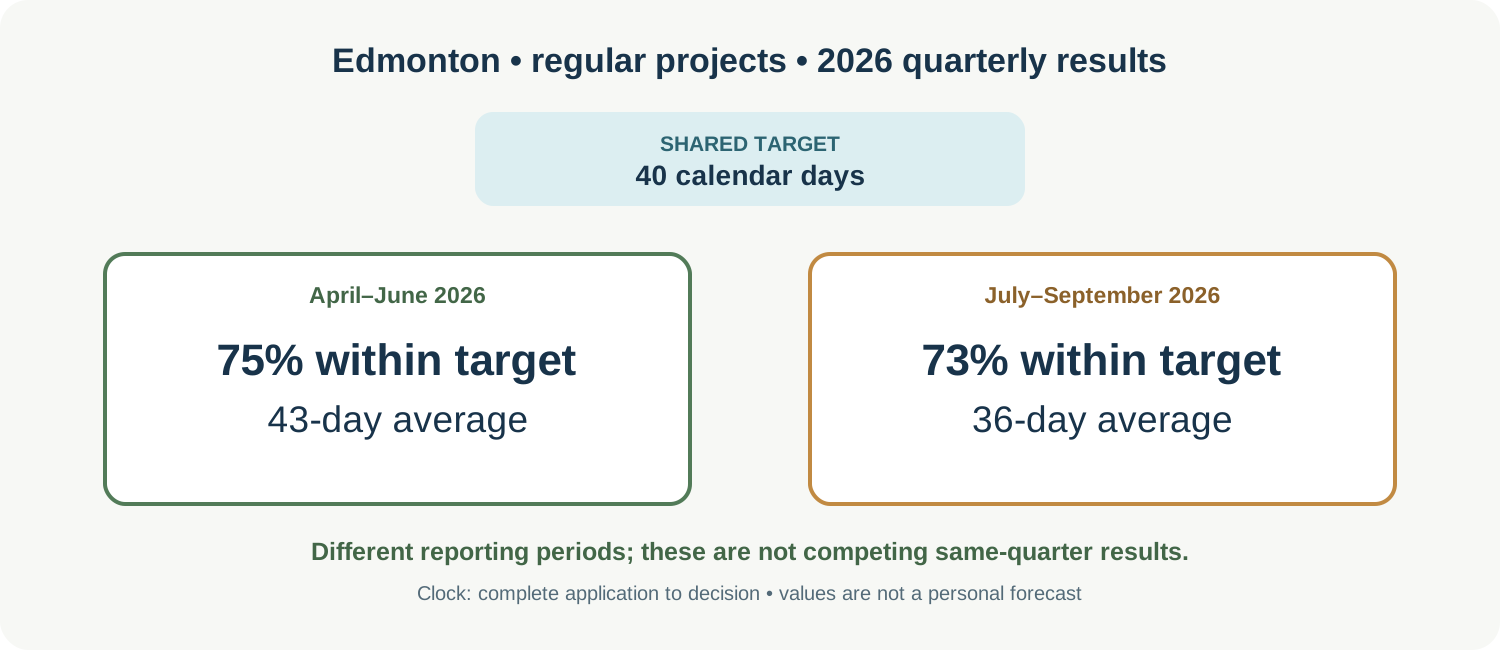
For example, the City of Edmonton’s processing-time report sets a 40-calendar-day target for regular projects, including secondary basement suites. The City measures from a complete application with fees paid to a decision. It is a service target for that project class, not a promise for an individual application.
For regular projects, including secondary basement suites, a City page view checked on October 24, 2026, reported 75% within target and a 43-day average for April–June 2026. The City’s July–September 2026 table reports 73% within target and a 36-day average. These are different reporting periods, not conflicting results for the same quarter. The 40-calendar-day target and complete-application-to-decision clock remain the same. The live page could not be retrieved on October 24, so confirm which figures are currently displayed before relying on them; neither measure includes later inspections or construction.
England’s building-regulations guidance gives expected decision periods for certain full-plans applications and a separate conditional period for a completion certificate after compliant work is finished. Those are different milestones. A local authority, application type, consent, corrections, and project facts can change what applies. Seattle also publishes initial-review targets for simple and complex applications; these are not end-to-end construction times.
Understand what can add time
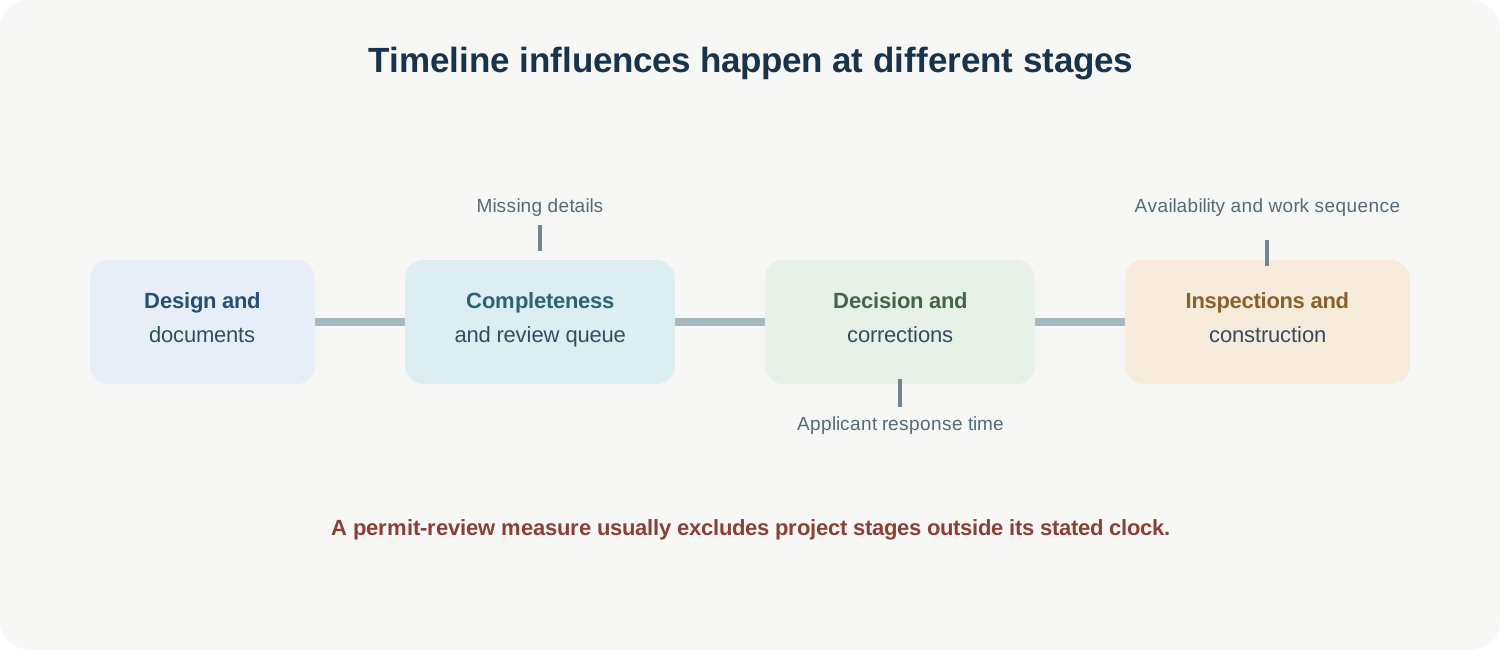
An incomplete or inconsistent application can be returned or delayed. Review may take longer when drawings need correction, a proposal needs specialist review, public notice or consultation applies, the authority has a queue, or the project needs separate utility, fire, environmental, heritage, or access decisions. Applicant response time and the availability of inspections also affect the calendar between milestones.
Some reviews can happen in parallel, while others depend on a prior decision or confirmation. Ask each authority when its clock starts, what pauses or restarts it, and whether a separate permit or inspection has its own service standard. A pre-application screen or document check may identify issues earlier, but it is not necessarily formal acceptance or approval.
Keep approval time separate from total project time
Permit review does not include all the time needed to survey and design a proposal, obtain consultant documents, revise drawings, arrange financing, construct the unit, complete corrections, or schedule every inspection. A stated review target cannot be used as a construction schedule or move-in date.
An English planning appeal after refusal or non-determination has its own eligibility rules, filing deadline, and decision clock. See the England appeal and non-determination guide for that separate process.
For a useful local estimate, ask the authority for the current target or recent performance measure for the exact permit class, its clock definition, current volume conditions, and the next inspection or completion milestones. Keep each answer dated and avoid adding separate clocks together unless the authority confirms they are sequential.