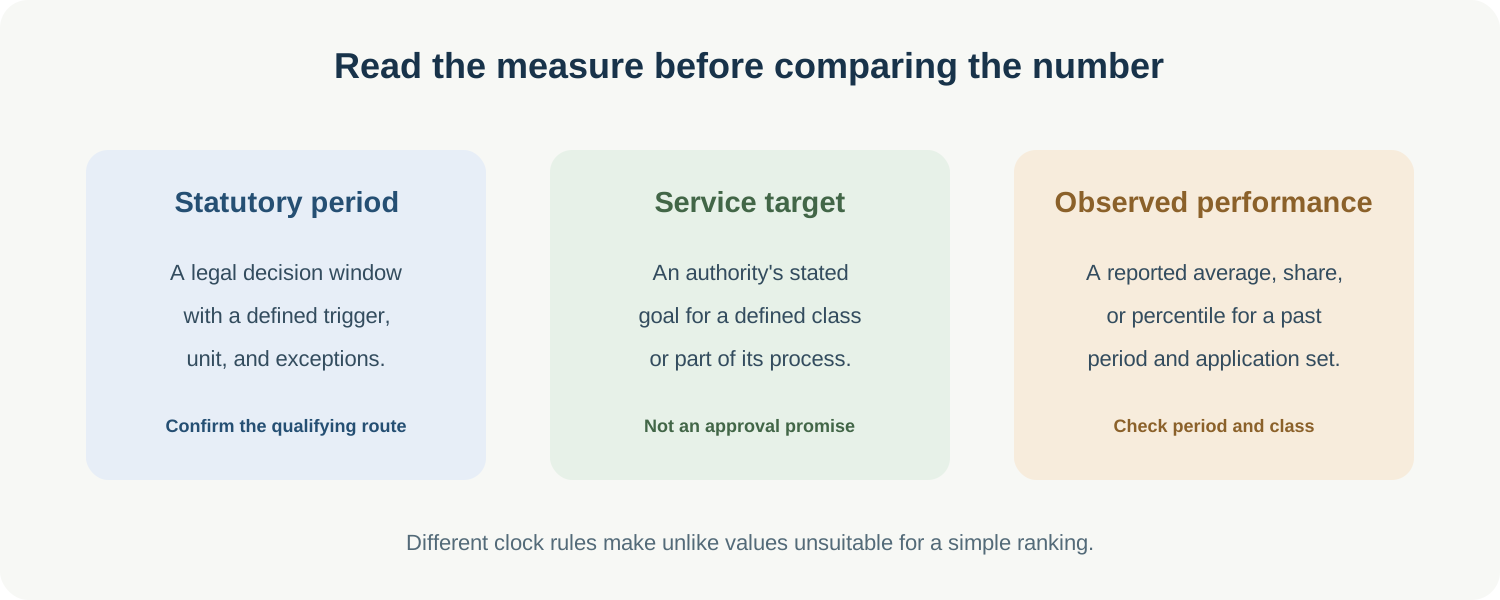
Official processing figures can help with planning, but they do not all measure the same part of an approval journey. One authority may report a target after a complete application; another may count only days when staff control the file; a third may publish an annual average across many application types. The examples below show how to read the clock before using the number.
Selected official measures
| Authority and application class | Published measure | Clock and limits |
|---|---|---|
| Seattle — pre-approved detached ADU (DADU) plan | SDCI’s page lists a 30-calendar-day goal for 75% of reviews and a displayed current 75th-percentile value of 60 days in City control. The goals are stated as effective October 1, 2025; the page was checked September 25, 2026. | The measure runs from formal intake to permit issuance and counts City-control days. It excludes time waiting for applicant corrections or fee payment; the applicant’s total elapsed time can be longer. See Seattle’s performance table. |
| Toronto — House Stream for detached or semi-detached houses and existing row houses with no more than two dwelling units, including garden and laneway suites | Complete applications are reviewed within 10 business days. | The clock applies after the signed form, plans and specifications, issued Zoning Applicable Law Certificate, applicable-law confirmation, and fees are in place. It is a review timeframe, not a promise of permit approval. See Toronto’s review-stream requirements. |
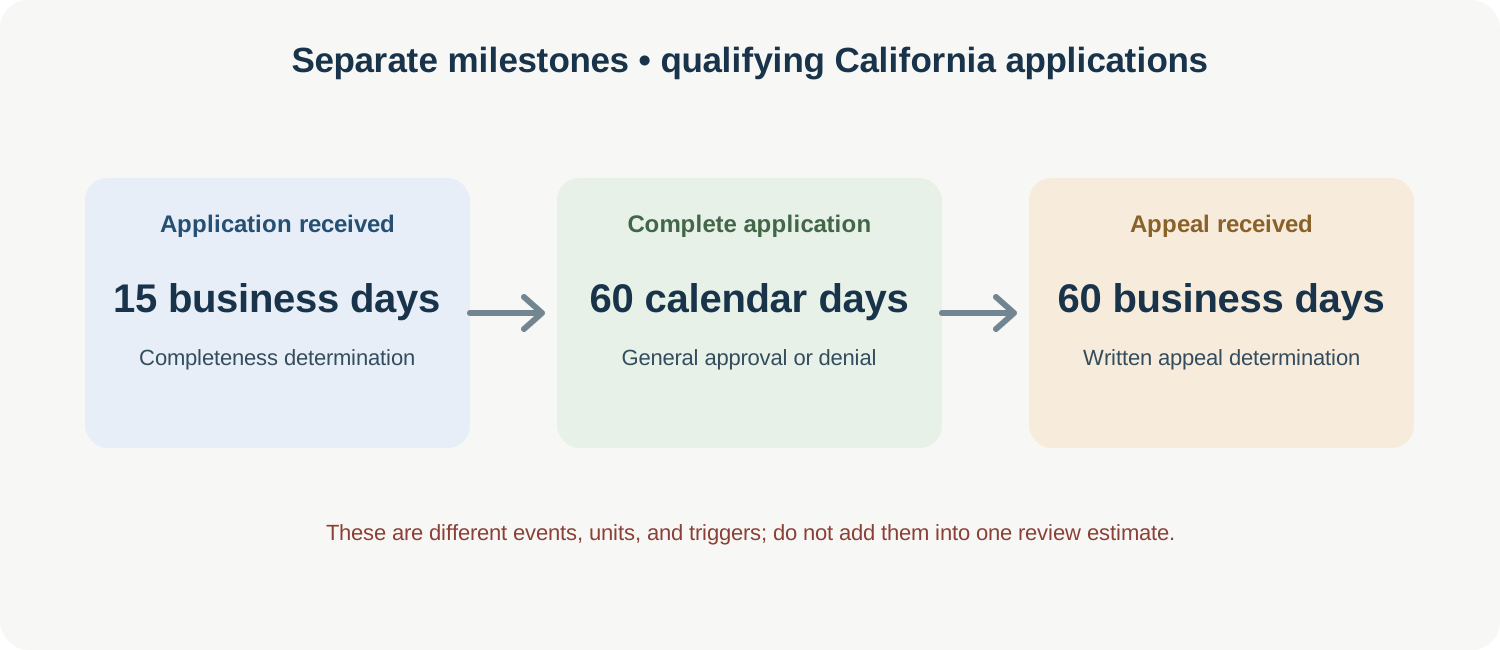
| California — applications under the state ADU/JADU law | Agencies must give a written completeness or incompleteness determination within 15 business days of receipt. For a qualifying application on a lot with an existing primary dwelling, the March 2026 handbook describes a general 60-day approval-or-denial period after receipt of a completed application. | These are separate statutory milestones. An applicant-requested delay tolls the general 60-day period. An appeal of an incompleteness determination or denial has its own final written determination deadline of 60 business days after the agency receives the appeal. Confirm eligibility and current requirements with the local agency. See the California ADU Handbook. |
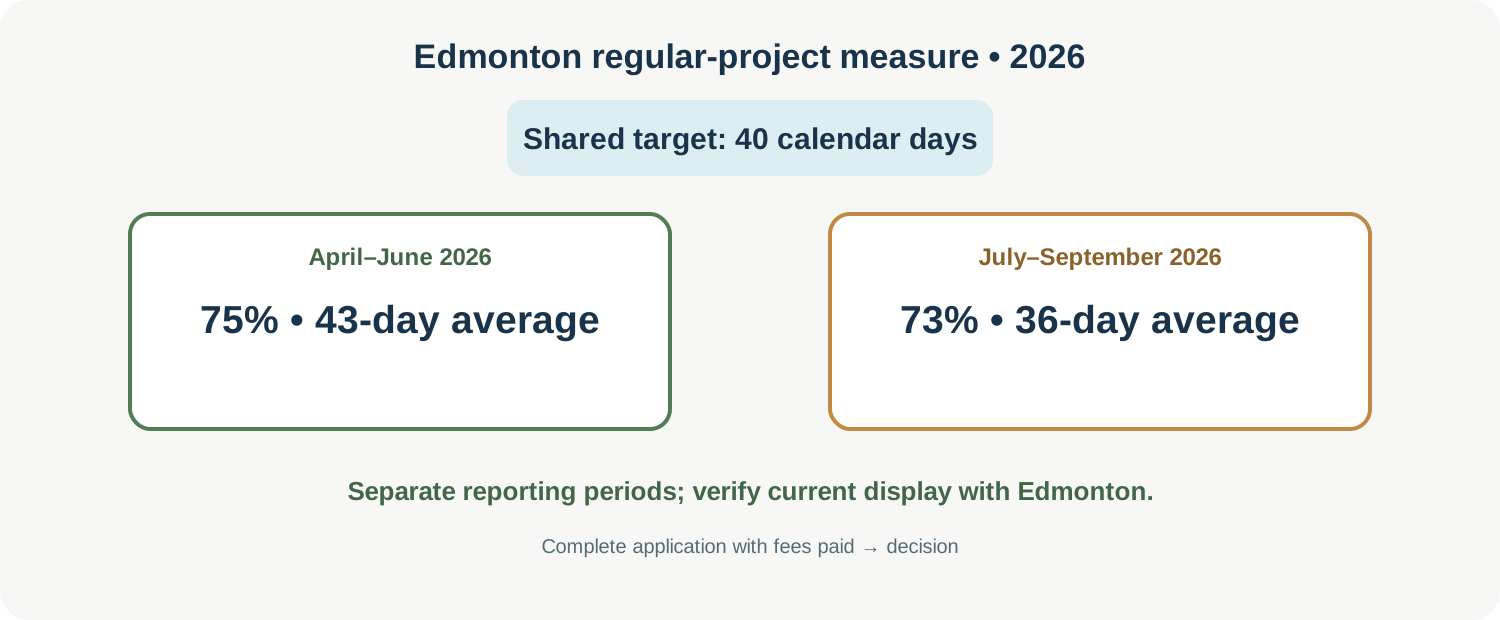
| Edmonton — regular home-improvement projects, including secondary basement suites | The target is 40 calendar days. A City page view checked October 24, 2026, reported 75% within target and a 43-day average for April–June 2026; the July–September 2026 table reports 73% and 36 days. | The clock starts with a complete application and paid fees and ends at a decision; required neighbour-notification or appeal periods are excluded. These actuals belong to different quarters, not competing readings of one period. The live page could not be retrieved on October 24; confirm the current values with Edmonton. See Edmonton’s processing-time report. |
| England — full-plans building-regulations applications for work outside higher-risk buildings | GOV.UK says to expect a decision within five weeks, or within two months with the applicant’s consent. A completion certificate is a separate milestone, usually expected within eight weeks after compliant work is completed. | The decision period and post-construction certificate period apply to different stages. Confirm the building-control body, application type, and project classification. See GOV.UK’s application guidance. |
| Scotland — building-warrant verification | The April 2026 verifier framework sets a three-month period from receipt for the verifier to determine the application or issue a first report. A separate determination period can run for nine months from the first report, unless a longer period is agreed. | A first report is not approval. Receipt, prescribed fees, reports, consultations, amended applications, and any agreed extension affect which procedural period applies. After a completion certificate is submitted, the verifier must notify the applicant of acceptance or rejection within 14 days. See the Scottish Government verifier framework. |
| Northern Ireland — local planning applications across all councils | The 2025/26 average was 19.6 weeks for local applications brought to a decision or withdrawal, compared with a 15-week target. | This is a historical, council-wide performance statistic, not an ADU-specific forecast or building-control timeframe. See the 2025/26 planning statistics bulletin. |
This is a selected comparison, not a complete North American or UK timeline table. No comparable Wales processing figure is shown here; ask the local planning and building-control authorities which current timeframes apply. A local project may also need separate zoning, utility, fire, environmental, heritage, or other decisions.
Additional local review stages
These city examples use different measures and should be read by their stated application class and milestone. Consult the linked authority page for the current application route and qualifications.
| Authority and application class | Published measure | Clock and limits |
|---|---|---|
| San Diego — ADU permit using City-preapproved plans | The January 2026 bulletin states a 30-day review for applications using preapproved plans. | The bulletin does not define the day type or precise clock start in that statement. This is not a total project duration or approval guarantee. See San Diego’s submittal guide. |
| Glendale, Arizona — site-plan review for a Permit-Ready ADU plan | 10 business days after the application is deemed complete. | This is site-plan review only. Permit and impact fees remain due later, and the page does not state an effective date for listed fees. See Glendale’s permit-ready plan guide. |
| Pleasanton — City-preapproved ADU plans | 7 business days, compared with 15 business days for standard applications. | The measure is for building-plan review; site-specific plans, studies, engineering, construction fees, and inspections may remain. See Pleasanton’s preapproved-plan guide. |
| Herriman — internal ADU plan review | Approximately 7–14 business days. | This is a plan-review estimate, not the full permit-to-rental path. See Herriman’s internal ADU guide. |
| Menlo Park — new ministerial ADU applications from January 1, 2026 | Initial completeness review within 15 business days; approval or denial within 60 calendar days after completeness is determined. | An incomplete resubmission starts a new 15-business-day review cycle. Required discretionary review occurs first and is outside these stated measures. See Menlo Park’s process page. |
| San Antonio — ADU technical review | Up to 3 business days for initial redline comments after the plan-review fee is paid. | This does not cover correction cycles, approval, permit issuance, inspection, or construction. See the San Antonio ADU process. |
| Oakland — ADU planning and building applications | Planning: 10–20 days from low to high complexity. Building: 10 days for an Engineer-of-the-Day review using City PBD preapproved ADU plans; 21 days for regular residential additions, alterations, or a new ADU. | Oakland defines the listed timelines as based on complete applications and business days Monday through Friday. Planning and building are separate measures and may both be required. See Oakland’s review guide. |
| Pasadena — current 374-square-foot Standard Plan route | Completeness review: 1–2 business days after submittal. Plan check: approximately 3–4 weeks; a correction resubmittal: approximately 2 weeks. | Separate invoices must be paid before review; the City does not state one total application-to-issuance clock. See Pasadena’s Standard Plan guide. |
Compare the same milestone
Before comparing two figures, write down:
- Authority and application class: A clock for a pre-approved detached design may not cover a conversion, an ordinary detached unit, or an existing suite.
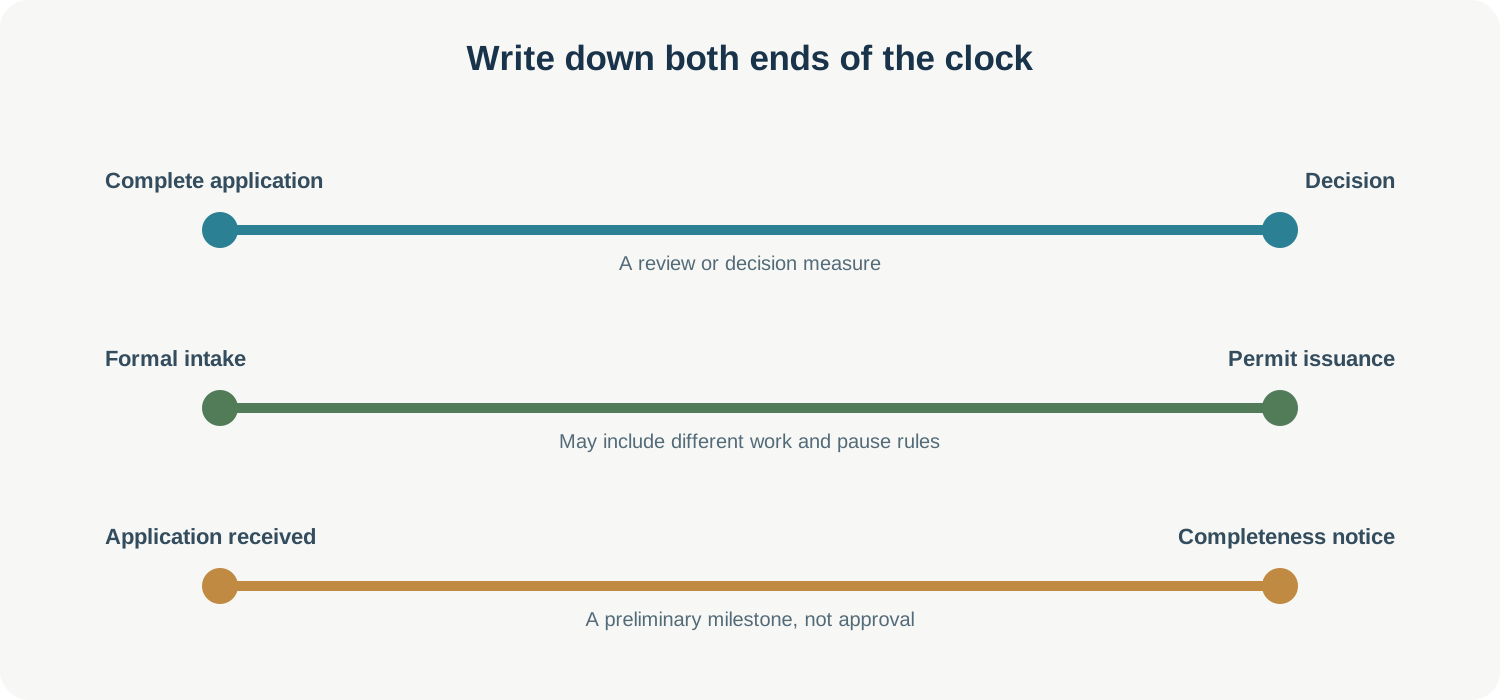
- Start point: Check whether the clock starts at submission, a complete application with fees, or formal intake after screening.
- End point: Distinguish completeness review, first report, decision, permit issuance, inspection, and completion certificate.
- Measure type: A statutory period, authority target, recent average, and percentile answer different questions.
- Reporting date and pauses: Record the reporting period, correction cycles, applicant response time, seasonal volume, and any agreed extension or tolling rule.
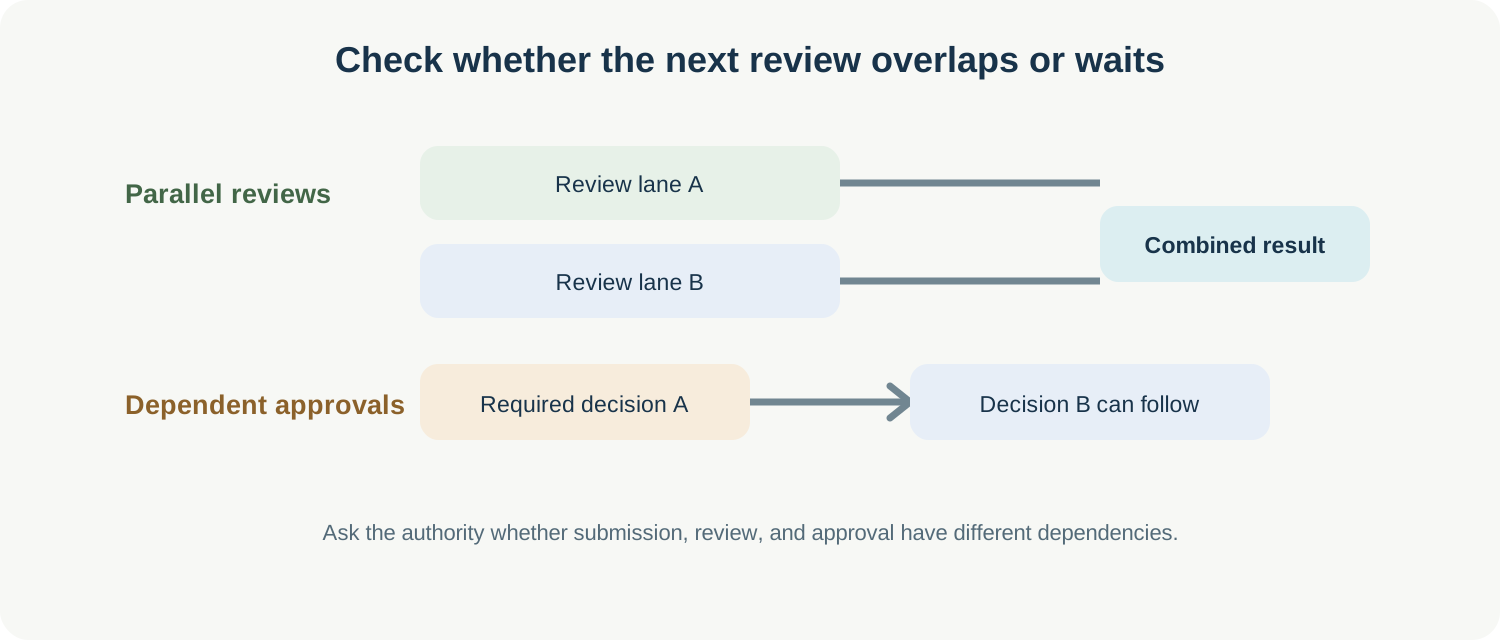
Do not add the figures in this table to estimate a total project duration. Some reviews can overlap; others begin only after a prior approval, correction, inspection, or certificate. Design, construction, utility work, and contractor scheduling may sit outside a permit-review measure.
For the practical steps to check a timeline for one proposed project, see how to interpret an ADU approval timeline. Confirm the current route and clock with the authority responsible for the property before relying on a date.