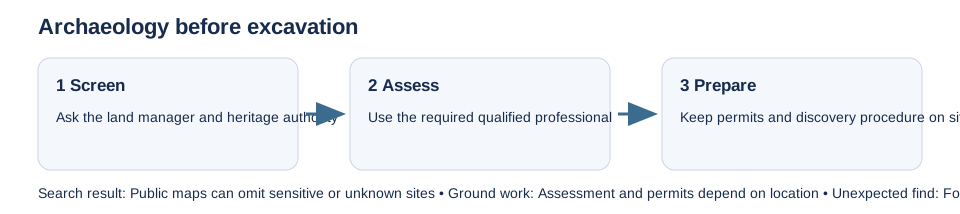
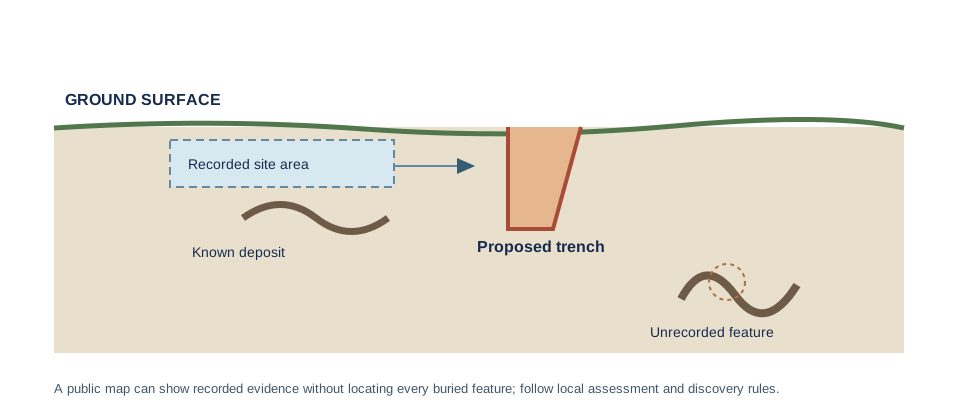
Archaeological checks are tied to land status, project review, and ground disturbance. A heritage register or public map can identify a lead, but many resources are unrecorded or withheld from public maps. Before clearing, excavation, grading, trenching, or foundation work, ask the authority whether screening, a licensed professional, assessment, or permit is required.
Routes differ by jurisdiction. Ontario uses a staged assessment process where an approval authority requires it; Saskatchewan and Alberta provide project-specific screening or approval pathways. New Brunswick distinguishes archaeological fieldwork permits from alteration near a known site and gives a separate procedure for possible discoveries. In the United States, federal archaeology permits attach to investigations on federal land, while private-land rules vary by state and locality. A federal Section 106 review applies through a federal undertaking and does not replace ordinary local approvals.
Before work, record the land manager, parcel, proposed disturbance, and any written screening response. Ask who may conduct fieldwork, whether a permit is needed before it starts, and what procedure applies if a find appears unexpectedly. Do not assume every discovery requires the same reporting or stop-work response; follow the applicable law and project instructions. Where Indigenous cultural resources may be involved, use the relevant consultation process rather than inferring it from a map.
Archaeological assessment is separate from scheduled-monument consent and from ordinary planning review. See the UK monument consent guide for that distinct route.